Showing posts with label Brutish Empire. Show all posts
Showing posts with label Brutish Empire. Show all posts
Thursday, 2 June 2011
Slaving for Europe's Salads
While Germany's freaking out over the revenge of the killer 'cucumbers' (insert name of responsible vegetable when known), I thought it would be a good time to post this video from earlier this year. While countries may take steps to curb the spread of E-coli, will there ever be as much of an outcry over the living conditions of some of those who grow the continent's vegetables?


Thursday, 26 May 2011
From Obama to O'bama
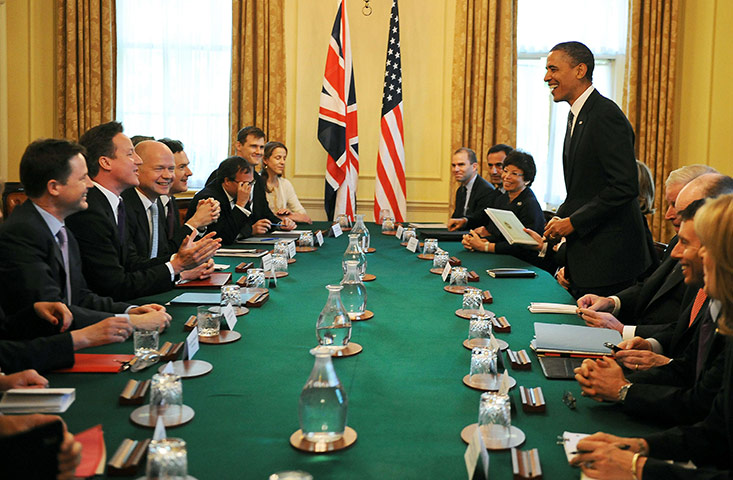
Barack Obama takes a seat for an expanded bilateral meeting with David Cameron and other delegates in the cabinet room
fotocredit: Jewel Samad/AFP/Getty
jacked from the Graun
"Obama speech came alive talking about diverse societies. But not one non-white person on British establishment side of stage."Though Miliband is part of the very political establishment he derides, this tweet hit home. It's been really weird, surreal even, watching Britain's political elites and media fawn over the Obamas. On Monday Obama was in Ireland visiting the village where his great great great maternal grandfather is said to have come from. And so Obama, or rather O'bama is now an Irishman. To prove it, the Guardian printed an opinion piece with a headline declaring 'Obama finds his inner Irishman.' And the Irish Times ran an interesting commentary by Gavin O'Malley on the political history of the Irish and Black American communities:
"the African American community responded by providing the votes needed to elect the first Irish Catholic president [John F. Kennedy]. The course of history changed. Black merged green and green merged black. Irish-Americans and African-Americans dropped their hyphens... and once again became one."For those who don't know much, it's informative, but it tends to recall only the good bits about Ireland's past and seems to leave out the bad bits. Seemingly, its o'kay to leave those bits out, as the most of the UK media has done, because on this occasion it's about celebrating the visit of O'bama the 'Irish' President of America. Balance and a more critical approach, would have been a little embarrassing because as there's been plenty of solidarity, there's also been plenty of oppression too. And though present-day Ireland and America certainly paints a better picture of oneness and a people bound by a common identity, it feels strange, but positive, but also weird to watch O'bama being welcomed with a pint of Guinness and a name change.
Even more awkward was Wednesday. Obama gave a speech in Westminster during which he mentioned his paternal grandfather:
"It is possible for the sons and daughters of former colonies to sit here as members of this great parliament and for the grandson of a Kenyan who served as a cook in the British army to stand before you as president of the United States,"Indeed Obama has proved it is possible for the grandson of a Kenyan cook to become President of USA, but the rapturous applause he got shows the bi-polar nature of parliament - which as David Miliband's tweet above notes, is quite unrepresentative. This is the same institution trying to wriggle out of compensating the Kenyans tortured under British colonial rule because the government is not responsible for what happened in its colonies. Obama ever the diplomat, didn't mention how cruelly the British treated his grandfather, a subject he oddly never mentions much. It's odd that, apart from Libya, the highlights of Obama's speech and general tone has been one of acknowledging migrant histories and the benefits of multiculturalism and yet this government believes in 'muscular multiculturalism' and ridiculously proposes no right of appeal on visa rejections. And now that immigration figures have just been released showing an increase in migrants coming on, one can expect to see the right hit the panic button and call for tougher immigration controls. So what was parliament clapping for or was it just the lily-livered lefties?
Wednesday, 25 May 2011
Democracy, Dictatorship and Disease
Every once in a while, scientists push the boundaries between good and bad science by making controversial claims about the relations between things. This latest theory by Randy Thornhill claims that a. the choice of governing system in a country is determined by the threat of disease b. the rate of prevalence of an infectious disease impacts negatively on the possibility of certain states developing more democratic systems of governance. Though the 'eugenics by any other name' alert went off instinctively in my brain, but then I read it. I think disease prevalence has more to do with climate AND access to resources, which in turn shape the style and level of democracy in a country. But on the other hand, diseases prevail because repressive governments are less willing or financially able to attend to the illnesses. A simple/simplistic example would be the cholera outbreak in Zimbabwe in 2009 in which +100 people died. The outbreak was due to bad sanitation because of the government's bad administration of Harare and the outbreak was worsened by government's slow response in providing clean water sources and supplying treatment. Though interesting, I still feel this study puts too much reliance on a single factor, yet there are multiple factors simultaneously at play. Anyway, because this article is that interesting/controversial, I decided to lift the whole article from the New Scientist (fisttap @viewfromthecave) because it's only available for seven days and you gotta sign up to access it. I feel this is important stuff that people should have access to, whenever they need to. Free access to information is the law of the digital jungle, paywalls and subscriptions are so elitist and exclusionary. And historically, in the field of science so much has been written and theorized about people and passed off as truth while the people themselves have no access to that information so they cannot verify or rebut anything, let alone speak for themselves.
Anyway here it is:
COMPARE these histories. In Britain, democracy evolved steadily over hundreds of years. During the same period, people living in what is now Somalia had many rulers, but almost all deprived them of the chance to vote. It's easy to find other stark contrasts. Citizens of the United States can trace their right to vote back to the end of the 18th century. In Syria, many citizens cannot trace their democratic rights anywhere - they are still waiting for the chance to take part in a meaningful election.
Conventional explanations for the existence of such contrasting political regimes involve factors such as history, geography, and the economic circumstances and culture of the people concerned, to name just a few. But the evolutionary biologist Randy Thornhill has a different idea. He says that the nature of the political system that holds sway in a particular country - whether it is a repressive dictatorship or a liberal democracy - may be determined in large part by a single factor: the prevalence of infectious disease.
It's an idea that many people will find outrageously simplistic. How can something as complex as political culture be explained by just one environmental factor? Yet nobody has managed to debunk it, and its proponents are coming up with a steady flow of evidence in its favour. "It's rather astonishing, and it could be true," says Carlos Navarrete, a psychologist at the Michigan State University in East Lansing.
Thornhill is no stranger to controversy, having previously co-authored A Natural History of Rape, a book proposing an evolutionary basis for rape. His iconoclastic theory linking disease to politics was inspired in part by observations of how an animal's development and behaviour can respond rapidly to physical dangers in a region, often in unexpected ways. Creatures at high risk of being eaten by predators, for example, often reach sexual maturity at a younger age than genetically similar creatures in a safer environment, and are more likely to breed earlier in their lives. Thornhill wondered whether threats to human lives might have similarly influential consequences to our psychology.
The result is a hypothesis known as the parasite-stress model, which Thornhill developed at the University of New Mexico, Albuquerque, with his colleague Corey Fincher.
Xenophobic instincts
The starting point for Thornhill and Fincher's thinking is a basic human survival instinct: the desire to avoid illness. In a region where disease is rife, they argue, fear of contagion may cause people to avoid outsiders, who may be carrying a strain of infection to which they have no immunity. Such a mindset would tend to make a community as a whole xenophobic, and might also discourage interaction between the various groups within a society - the social classes, for instance - to prevent unnecessary contact that might spread disease. What is more, Thornhill and Fincher argue, it could encourage people to conform to social norms and to respect authority, since adventurous behaviour may flout rules of conduct set in place to prevent contamination.
Taken together, these attitudes would discourage the rich and influential from sharing their wealth and power with those around them, and inhibit the rest of the population from going against the status quo and questioning the authority of those above them. This is clearly not a situation conducive to democracy. When the threat of disease eases, however, these influences no longer hold sway, allowing forces that favour a more democratic social order to come to the fore.
That's the idea, anyway. But where is the evidence?
The team had some initial support from earlier studies that had explored how a fear of disease affects individual attitudes. In 2006, for example, Navarrete found that when people are prompted to think about disgusting objects, such as spoilt food, they become more likely to express nationalistic values and show a greater distrust of foreigners (Evolution and Human Behavior, vol 27, p 270). More recently, a team from Arizona State University in Tempe found that reading about contagious illnesses made people less adventurous and open to new experiences, suggesting that they have become more inward looking and conformist (Psychological Science, vol 21, p 440).
Temporarily shifting individual opinions is one thing, but Thornhill and Fincher needed to show that these same biases could change the social outlook of a whole society. Their starting point for doing so was a description of cultural attitudes called the "collectivist-individualist" scale. At one end of this scale lies the collectivist outlook, in which people place the overall good of society ahead of the freedom of action of the individuals within it. Collectivist societies are often, though not exclusively, characterised by a greater respect for authority - if it's seen as being necessary for the greater good. They also tend to be xenophobic and conformist. At the other end there is the individualist viewpoint, which has more emphasis on openness and freedom for the individual.
Pathogen peril
In 2008, the duo teamed up with Damian Murray and Mark Schaller of the University of British Columbia in Vancouver, Canada, to test the idea that societies with more pathogens would be more collectivist. They rated people in 98 different nations and regions, from Estonia to Ecuador, on the collectivist-individualist scale, using data from questionnaires and studies of linguistic cues that can betray a social outlook. Sure enough, they saw a correlation: the greater the threat of disease in a region, the more collectivist people's attitudes were (Proceedings of the Royal Society B, vol 275, p 1279). The correlation remained even when they controlled for potential confounding factors, such as wealth and urbanisation.
A study soon followed showing similar patterns when comparing US states. In another paper, Murray and Schaller examined a different set of data and showed that cultural differences in one collectivist trait - conformity - correlate strongly with disease prevalence (Personality and Social Psychology Bulletin, vol 37, p 318).
Thornhill and Fincher's next challenge was to find evidence linking disease prevalence not just with cultural attitudes but with the political systems they expected would go with them. To do so, they used a 66-point scale of pathogen prevalence, based on data assembled by the Global Infectious Diseases and Epidemiology Online Network. They then compared their data set with indicators that assess the politics of a country. Democracy is a tough concept to quantify, so the team looked at a few different measures, including the Freedom House Survey, which is based on the subjective judgements of a team of political scientists working for an independent American think tank, and the Index of Democratization, which is based on estimates of voter participation (measured by how much of a population cast their votes and the number of referendums offered to a population) and the amount of competition between political parties.
The team's results, published in 2009, showed that each measure varied strongly with pathogen prevalence, just as their model predicted (Biological Reviews, vol 84, p 113). For example, when considering disease prevalence, Somalia is 22nd on the list of nations, while the UK comes in 177th. The two countries come out at opposite ends of the democratic scale (see "An infectious idea").
Read more: Explore the full data with our interactive graphic
Importantly, the relationship still holds when you look at historical records of pathogen prevalence. This, together with those early psychological studies of immediate reactions to disease, suggests it is a nation's health driving its political landscape, and not the other way around, according to the team.
Last year, they published a second paper that used more detailed data of the diseases prevalent in each region. They again found that measures of collectivism and democracy correlate with the presence of diseases that are passed from human to human - though not with the prevalence of diseases transmitted directly from animals to humans, like rabies (Evolutionary Psychology, vol 8, p 151). Since collectivist behaviours would be less important for preventing such infections, this finding fits with Thornhill and Fincher's hypothesis.
"Thornhill's work strikes me as interesting and promising," says Ronald Inglehart, a political scientist at the University of Michigan in Ann Arbor who was unaware of it before we contacted him. He notes that it is consistent with his own finding that a society needs to have a degree of economic security before democracy can develop. Perhaps this goes hand in hand with a reduction in disease prevalence to signal the move away from collectivism, he suggests.
Inglehart's comments nevertheless highlights a weakness in the evidence so far assembled in support of the parasite-stress model. An association between disease prevalence and democracy does not necessarily mean that one drives the other. Some other factor may drive both the prevalence of disease in an area and its political system. In their 2009 paper, Thornhill and Fincher managed to eliminate some of the possible "confounders". For example, they showed that neither a country's overall wealth nor the way it is distributed can adequately explain the link between the prevalence of disease there and how democratic it is.
But many other possibilities remain. For example, pathogens tend to be more prevalent in the tropics, so perhaps warmer climates encourage collectivism. Also, many of the nations that score high for disease and low for democracy are in sub-Saharan Africa, and have a history of having been colonised, and of frequent conflict and foreign exploitation since independence. Might the near-constant threat of war better explain that region's autocratic governments? There's also the possibility that education and literacy would have an impact, since better educated people may be more likely to question authority and demand their rights to a democracy. Epidemiologist Valerie Curtis of the London School of Hygiene and Tropical Medicine thinks such factors might be the ones that count, and says the evidence so far does not make the parasite-stress theory any more persuasive than these explanations.
Furthermore, some nations buck the trend altogether. Take the US and Syria, for example: they have sharply contrasting political systems but an almost identical prevalence of disease. Though even the harshest critic of the theory would not expect a perfect correlation, such anomalies require some good explanations.
Also lacking so far in their analysis is a coherent account of how historical changes in the state of public health are linked to political change. If Thornhill's theory is correct, improvements in a nation's health should lead to noticeable changes in social outlook. Evidence consistent with this idea comes from the social revolution of the 1960s in much of western Europe and North America, which involved a shift from collectivist towards individualist thinking. This was preceded by improvements in public health in the years following the second world war - notably the introduction of penicillin, mass vaccination and better malaria control.
There are counter-examples, too. It is not clear whether the opening up of European society during the 18th century was preceded by any major improvements in people's health, for example. Nor is there yet any clear evidence linking the current pro-democracy movements in the Middle East and north Africa to changes in disease prevalence. The theory also predicts that episodes such as the recent worldwide swine-flu epidemic should cause a shift away from democracy and towards authoritarian, collectivist attitudes. Yet as Holly Arrow, a psychologist at the University of Oregon in Eugene, points out, no effect has been recorded.
Mysterious mechanisms
To make the theory stick, Thornhill and his collaborators will also need to provide a mechanism for their proposed link between pathogens and politics. If cultural changes are responsible, young people might learn to avoid disease - and outsiders - from the behaviour of those around them. Alternatively, the reaction could be genetically hard-wired. So far, it has not proved possible to eliminate any of the possible mechanisms. "It's an enormous set of unanswered questions. I expect it will take many years to explore," Schaller says.
One possible genetic explanation involves 5-HTTLPR, a gene that regulates levels of the neurotransmitter serotonin. People carrying the short form of the gene are more likely to be anxious and to be fearful of health risks, relative to those with the long version. These behaviours could be a life-saver if they help people avoid situations that would put them at risk of infection, so it might be expected that the short version of the gene is favoured in parts of the world where disease risk is high. People with the longer version of 5-HTTLPR, on the other hand, tend to have higher levels of serotonin and are therefore more extrovert and more prone to risk-taking. This could bring advantages such as an increased capacity to innovate, so the long form of the gene should be more common in regions relatively free from illness.
That pattern is exactly what neuroscientists Joan Chiao and Katherine Blizinsky at Northwestern University in Evanston, Illinois, have reported in a paper published last year. Significantly, nations where the short version of the gene is more common also tend to have more collectivist attitudes (Proceedings of the Royal Society B, vol 277, p 529).
It is only tentative evidence, and some doubt that Chiao and Blizinsky's findings are robust enough to support their conclusions (Proceedings of the Royal Society B, vol 278, p 329). But if the result pans out with further research, it suggests the behaviours involved in the parasite-stress model may be deeply ingrained in our genetic make-up, providing a hurdle to more rapid political change in certain areas. While no one is saying that groups with a higher proportion of short versions of the gene will never develop a democracy, the possibility that some societies are more genetically predisposed to it than others is nevertheless an uncomfortable idea to contemplate.
Should the biases turn out to be more temporary - if flexible psychological reactions to threat, or cultural learning, are the more important mechanisms - the debate might turn to potential implications of the theory. Projects aiming to improve medical care in poor countries might also lead a move to more democratic and open governments, for example, giving western governments another incentive to fund these schemes. "The way to develop a region is to emancipate it from parasites," says Thornhill.
Remarks like that seem certain to attract flak. Curtis, for instance, bristled a little when New Scientist put the idea to her, pointing out that the immediate threat to human life is a pressing enough reason to be concerned about infectious disease.
Thornhill still has a huge amount of work ahead of him if he is to provide a convincing case that will assuage all of these doubts. In the meantime, his experience following publication of A Natural History of Rape has left him prepared for a hostile reception. "I had threats by email and phone," he recalls. "You're sometimes going to hurt people's feelings. I consider it all in a day's work."
Jim Giles is a New Scientist correspondent based in San Francisco
Wednesday, 16 February 2011
All Africa: Egypt, Tunisia & Gabon

All of this is Africa, and all the people born here are from Africa
By the time I'm done with this blog post I hope it doesn't read as a jumbled rant but I'm raging about so many issues all at the same time. First off I just want to say the media's full of sh!t. I don't swear often but this time I feel like it and I meant it. They're all full of sh!t. Even my beloved Al Jazeera and The Guardian. Why? Because they suck. There have been protests going on in Gabon since the 29th of January and up till now they've not picked up on the story, they've been busy with Middle East and North Africa coverage that the demonstrations in a small West Central African nation aren't worthy of media attention.
Julie Owono of Global Voices reports that this is the result of a long running dispute over the 2009 elections that Ali Bongo (son of Omar Bongo) is said to have won. Gabon's opposition leaders along with former presidential hopeful Andre Mba Obame then formed a breakaway government on January 26 and Mba Obame swore himself in as President of Gabon. Ministers were appointed to Mba Obame's cabinet, even though its unclear how the Minister of Foreign Affairs would take up the position as he is currently resident in France. Supporters of Mba Obame in the capital, Libreville marched to the UN offices and demanded that the UN recognize him as President. It has since emerged that the base of the unofficial government is in the the UNDP offices. On January 29, thousands of supporters marched in the streets of Libreville, but were violently crushed by the army. Fast forward to 10 February, students at the University of Omar Bongo added their voices to the dissent but for different reasons. Owono writes that:
"According to website La Voix du Peuple Gabonais (Voice of the Gabonese People - LVDPG) [fr], an online newspaper managed by Gabonese living abroad, students were demonstrating [fr] because they have not received their 100 Euros (66,000 Central African Francs) monthly scholarship money since July 2010."
The student grievances are also about the poor conditions at the university, police brutality against student demonstrators and they demand the 'reinstatement of three professors' who are aligned with the opposition. There's a protest scheduled for the 21st of February calling for Ali Bongo's departure (Ali Bongo Degage) and although SMS-es have been sent out to people, the authorities have in the past done a good job of ensuring the message does not spread across the country so there is a possibility that this march could be crushed too (as were those on 5 & 8 February).
But all this political drama in less than a month and not one headline from a major news outlet? Would it help if it was known that during all this unrest, on 9 February, Nicolas Sarkozy sent birthday wishes to Ali Bongo? Or that one of the chants is 'Ben Ali Gone, Ali Ben Degage' making the clear connection to Tunisia? Isn't this also one of those social media uprisings and domino-effect revolutions that are oh-so trendy right now? The Gabonese have used Facebook, SMS, YouTube and Twitter just like the Egyptians, Algerians, Libyans and Bahrainis. So why have they been ignored? An unofficial government housing itself in a UNDP building is pretty significant one would think. Does Ban Ki Moon not give a hoot that the UN's premises are being occupied by potential revolutionaries? Even his standard 'we strongly condemn violence blah blah respect human rights blah blah blah' is needed, just say something! African Union, same ting! Maybe Gabon needs self-immolating martyrs so they can go mainstream and Anderson Cooper can be sent in to do coverage in the 'heart of Africa.' Or maybe Sarkozy should explain that when he says France supports Gabon in his birthday message to Bongo he actually means he'll send teargas and live ammunition, in the tradition of what Chirac and Mitterand used to do for daddy Bongo - that would get tongues wagging, wouldn't it? Or even better, a few people can burn themselves and the Muslim minority in Gabon can invent ties with the Muslim Brotherhood in Egypt then Al Jazeera will come running. Good, no?
Sadly this lack of attention isn't only from leading Western or Arab media, but leading African newspapers as well like South Africa's Mail and Guardian. Their coverage on South Africa is pretty good, but being the frustrated critical reader that I am living in this digital era of information-obesity where stories break by the minute, I find the Africa coverage very disappointing and even moreso when compared to other mainstream global media. If it's not a story on Kenya, the Congo, Sudan, Somalia, Cote d'Ivoire or Zimbabwe it doesn't get coverage until AP (Associated Press), Reuters or the Guardian UK does a story on it. And if they don't copy n paste from AP and Reuters it probably won't get covered. I'm not surprised they've not covered it, but I'm irritated that they've missed out on an important story. Yet again. (Yes, their coverage of Wikileaks Africa cables hasn't been great. Its slanted towards Assange, the moral ethics of Wikileaks and the big stories, but very little analysis (!!!) or reportage on the Africa cables outside of the big gossip and corruption stories from the usual countries, yet Morocco, Djibouti, Mauritius, Madagascar and Diego Garcia were pretty important cables that got missed.)
But back to the subject of the role of new social media in protest. Yesterday at the New Statesman Laurie Penny wrote this:
"The instant dissemination of camera and video footage and reportage from citizen journalists means that the truth can travel around the world before government propaganda gets its boots on."
To which I responded:
"But what happens when that truth gets ignored by mainstream media? Oppressive regimes will continue to oppress people so inasmuch as it's great that social media helps communicate a message if the influential people aren't listening then what? Can we really speak of 'social media revolutions' and even speedy dissemination of truth when it took over a month before mainstream media picked up on Tunisia? There have been anti-government protests in Gabon since 26 January, influenced in part by events in Tunisia, but there's been NO Anglophone media coverage, apart from Global Voices and the Daily Maverick (S.A). As with Tunisia, it's alternative outlets that have been leading on this story esp Global Voices, while the rest of mainstream media are still looking for different angles to reproduce the headline stories. If anything, the more popular something is the more coverage it gets and calling things 'social media revolution' is much nicer and more palatable for the masses than things like brutality, poverty and unemployment, so the truth of oppression spread through social media becomes masked again."
"But what happens when that truth gets ignored by mainstream media? Oppressive regimes will continue to oppress people so inasmuch as it's great that social media helps communicate a message if the influential people aren't listening then what? Can we really speak of 'social media revolutions' and even speedy dissemination of truth when it took over a month before mainstream media picked up on Tunisia? There have been anti-government protests in Gabon since 26 January, influenced in part by events in Tunisia, but there's been NO Anglophone media coverage, apart from Global Voices and the Daily Maverick (S.A). As with Tunisia, it's alternative outlets that have been leading on this story esp Global Voices, while the rest of mainstream media are still looking for different angles to reproduce the headline stories. If anything, the more popular something is the more coverage it gets and calling things 'social media revolution' is much nicer and more palatable for the masses than things like brutality, poverty and unemployment, so the truth of oppression spread through social media becomes masked again."
I don't know if Laurie Penny saw my post and even if she did, then what? Will she actually write about Gabon or more likely pass it onto on of her colleagues at the New Statesman more knowledgeable in African affairs? Yea, keep hope alive. Maybe the Guardian will keep their promise to follow up on my comment today about lack of Gabon coverage, but if they did it won't make them any less sh!t. They were late.
And despite the brilliance of my beloved Guardian and Al Jazeera, they've also been a bit disappointing because their analysts have had little to say about the very real impact of Tunisia, Egypt, Lybia and Algeria on Africa. The Arab uprisings have been looked at mainly from a pan-Arab and Arab-West perspective and yet these events have had a global impact. Citizen-State power relations aren't just shifting in these two spheres but on the Afrian Continent as a whole and in many other parts of the world too. Alongside the Graun & Al J, I've also watched and read the BBC, The Atlantic and NY Times and they all do the same thing. I'm not sure why this recent series of events has only been seen from a Arab-Middle East lens and not through a Arab-Africa lens as well. Egypt, Tunisia, Libya, Sudan and Algeria are all Arab nations in Africa. But expert upon expert writing or talking to the media has looked at this from a Middle Eastern/North Africa/Arab perspective as though these protests would have no effect on the land below the Sahara. Or as though North African / Arab Africa, doesn't mean African or Africa (see map above). Pity the poor writers across the Continent who've enthusiastically written about this from an African perspective and pity the Gabonese who've found inspiration from 'the Arab World' but whose voices aren't being heard. Even more frightening though, is the five men who've been abducted in Zimbabwe for celebrating Mubarak's downfall, Zimbabwean state tv censorship of Egypt news and in Malawi, protesters against the recent fuel price hike were detained for several hours by the police because their demonstration was illegal and Bingu Mutharika warned Malawians not to copy Cairo. (But they're not listening) Mutharika, Mugabe, Mubarak, Gadaffi, Bongo were/are all strong men in Africa. Too bad everyone's busy reporting this as 'the Arab revolution' to also notice its many faces. The ripple effect of a rock thrown in a pool of fury doesn't flow one way, but in concentric patterns so that even those on the southern most tip of the continent will feel what is happening on its most northern tip.
#rantover
much thanks to Julie Owono, Ethan Zuckerman and many other silent bloggers for caring enough to write about this.
UPDATE: GABON: A 38 year old woman, mother of two and anti-Bongo protestor, Marie Mendome has died as a result of injuries from a police beating. She died on Sunday but the story's only started circulating in my spheres, today. Read about it here. How many more deaths will it take before this story gets a headline?
Friday, 11 February 2011

Wednesday, 9 February 2011
California on Egypt
While the Pew Research Centre has produced some very interesting research* to dispel the myth that Americans are not as ignorant as the rest of the world sometimes thinks they are, some young people Cali are simply clueless.
This is Kaseem G on the streets of Cali.
#subscribetokaseemg!
* Pew Reasearch shows that +-32% of the public said that they kept up with news about the situation in Egypt and the Egyptian Revolution made up 56% of media coverage last week. This is said to be one of the 'highest levels of coverage for any story since PEJ started its weekly analysis four years ago -- and the highest for a foreign news story'. Kind of surprising given that America's fighting two wars and has military and humanitarian interests in so many countries around the world.
Thursday, 3 February 2011
Sandmonkey's Last Post
The Egyptian Blogger Sandmonkey was arrested by Egyptian state forces earlier hour this morning. The officers who answered his phone when his father called also threatened to arrest his father as well. Shortly after this his blog was taken off-line, but fortunately some people had mirrored his last post and I'm posting it here as well, we pray he's alright.:
SandMoney - Egypt, right now!
Thursday, 3 Feb 2011
Egypt, right now!
I don't know how to start writing this. I have been battling fatigue for not sleeping properly for the past 10 days, moving from one's friend house to another friend's house, almost never spending a night in my home, facing a very well funded and well organized ruthless regime that views me as nothing but an annoying bug that its time to squash will come. The situation here is bleak to say the least.
It didn't start out that way. On Tuesday Jan 25 it all started peacefully, and against all odds, we succeeded to gather hundreds of thousands and get them into Tahrir Square, despite being attacked by Anti-Riot Police who are using sticks, tear gas and rubber bullets against us. We managed to break all of their barricades and situated ourselves in Tahrir. The government responded by shutting down all cell communication in Tahrir square, a move which purpose was understood later when after midnight they went in with all of their might and attacked the protesters and evacuated the Square. The next day we were back at it again, and the day after. Then came Friday and we braved their communication blackout, their thugs, their tear gas and their bullets and we retook the square. We have been fighting to keep it ever since.
That night the government announced a military curfew, which kept getting shorter by the day, until it became from 8 am to 3 pm. People couldn't go to work, gas was running out quickly and so were essential goods and money, since the banks were not allowed to operate and people were not able to collect their salary. The internet continued to be blocked, which affected all businesses in Egypt and will cause an economic meltdown the moment they allow the banks to operate again. We were being collectively punished for daring to say that we deserve democracy and rights, and to keep it up, they withdrew the police, and then sent them out dressed as civilians to terrorize our neighborhoods. I was shot at twice that day, one of which with a semi-automatic by a dude in a car that we the people took joy in pummeling. The government announced that all prisons were breached, and that the prisoners somehow managed to get weapons and do nothing but randomly attack people. One day we had organized thugs in uniforms firing at us and the next day they disappeared and were replaced by organized thugs without uniforms firing at us. Somehow the people never made the connection.
Despite it all, we braved it. We believed we are doing what's right and were encouraged by all those around us who couldn't believe what was happening to their country. What he did galvanized the people, and on Tuesday, despite shutting down all major roads leading into Cairo, we managed to get over 2 million protesters in Cairo alone and 3 million all over Egypt to come out and demand Mubarak's departure. Those are people who stood up to the regime's ruthlessness and anger and declared that they were free, and were refusing to live in the Mubarak dictatorship for one more day. That night, he showed up on TV, and gave a very emotional speech about how he intends to step down at the end of his term and how he wants to die in Egypt, the country he loved and served. To me, and to everyone else at the protests this wasn't nearly enough, for we wanted him gone now. Others started asking that we give him a chance, and that change takes time and other such poppycock. Hell, some people and family members cried when they saw his speech. People felt sorry for him for failing to be our dictator for the rest of his life and inheriting us to his Son. It was an amalgam of Stockholm syndrome coupled with slave mentality in a malevolent combination that we never saw before. And the Regime capitalized on it today.
Today, they brought back the internet, and started having people calling on TV and writing on facebook on how they support Mubarak and his call for stability and peacefull change in 8 months. They hung on to the words of the newly appointed government would never harm the protesters, whom they believe to be good patriotic youth who have a few bad apples amongst them. We started getting calls asking people to stop protesting because "we got what we wanted" and "we need the country to start working again". People were complaining that they miss their lives. That they miss going out at night, and ordering Home Delivery. That they need us to stop so they can resume whatever existence they had before all of this. All was forgiven, the past week never happened and it's time for Unity under Mubarak's rule right now.
To all of those people I say: NEVER! I am sorry that your lives and businesses are disrupted, but this wasn't caused by the Protesters. The Protesters aren't the ones who shut down the internet that has paralyzed your businesses and banks: The government did. The Protesters weren't the ones who initiated the military curfew that limited your movement and allowed goods to disappear off market shelves and gas to disappear: The government did. The Protesters weren't the ones who ordered the police to withdraw and claimed the prisons were breached and unleashed thugs that terrorized your neighborhoods: The government did. The same government that you wish to give a second chance to, as if 30 years of dictatorship and utter failure in every sector of government wasn't enough for you. The Slaves were ready to forgive their master, and blame his cruelty on those who dared to defy him in order to ensure a better Egypt for all of its citizens and their children. After all, he gave us his word, and it's not like he ever broke his promises for reform before or anything.
Then Mubarak made his move and showed them what useful idiots they all were.
You watched on TV as "Pro-Mubarak Protesters" – thugs who were paid money by NDP members by admission of High NDP officials- started attacking the peaceful unarmed protesters in Tahrir square. They attacked them with sticks, threw stones at them, brought in men riding horses and camels- in what must be the most surreal scene ever shown on TV- and carrying whips to beat up the protesters. And then the Bullets started getting fired and Molotov cocktails started getting thrown at the Anti-Mubarak Protesters as the Army standing idly by, allowing it all to happen and not doing anything about it. Dozens were killed, hundreds injured, and there was no help sent by ambulances. The Police never showed up to stop those attacking because the ones who were captured by the Anti-mubarak people had police ID's on them. They were the police and they were there to shoot and kill people and even tried to set the Egyptian Museum on Fire. The Aim was clear: Use the clashes as pretext to ban such demonstrations under pretexts of concern for public safety and order, and to prevent disunity amongst the people of Egypt. But their plans ultimately failed, by those resilient brave souls who wouldn't give up the ground they freed of Egypt, no matter how many live bullets or firebombs were hurled at them. They know, like we all do, that this regime no longer cares to put on a moderate mask. That they have shown their true nature. That Mubarak will never step down, and that he would rather burn Egypt to the ground than even contemplate that possibility.
In the meantime, State-owned and affiliated TV channels were showing coverage of Peaceful Mubarak Protests all over Egypt and showing recorded footage of Tahrir Square protest from the night before and claiming it's the situation there at the moment. Hundreds of calls by public figures and actors started calling the channels saying that they are with Mubarak, and that he is our Father and we should support him on the road to democracy. A veiled girl with a blurred face went on Mehwer TV claiming to have received funding by Americans to go to the US and took courses on how to bring down the Egyptian government through protests which were taught by Jews. She claimed that AlJazeera is lying, and that the only people in Tahrir square now were Muslim Brotherhood and Hamas. State TV started issuing statements on how the people arrested Israelis all over Cairo engaged in creating mayhem and causing chaos. For those of you who are counting this is an American-Israeli-Qatari-Muslim Brotherhood-Iranian-Hamas conspiracy. Imagine that. And MANY PEOPLE BOUGHT IT. I recall telling a friend of mine that the only good thing about what happened today was that it made clear to us who were the idiots amongst our friends. Now we know.
Now, just in case this isn't clear: This protest is not one made or sustained by the Muslim Brotherhood, it's one that had people from all social classes and religious background in Egypt. The Muslim Brotherhood only showed up on Tuesday, and even then they were not the majority of people there by a long shot. We tolerated them there since we won't say no to fellow Egyptians who wanted to stand with us, but neither the Muslims Brotherhood not any of the Opposition leaders have the ability to turn out one tenth of the numbers of Protesters that were in Tahrir on Tuesday. This is a revolution without leaders. Three Million individuals choosing hope instead of fear and braving death on hourly basis to keep their dream of freedom alive. Imagine that.
The End is near. I have no illusions about this regime or its leader, and how he will pluck us and hunt us down one by one till we are over and done with and 8 months from now will pay people to stage fake protests urging him not to leave power, and he will stay "because he has to acquiesce to the voice of the people". This is a losing battle and they have all the weapons, but we will continue fighting until we can't. I am heading to Tahrir right now with supplies for the hundreds injured, knowing that today the attacks will intensify, because they can't allow us to stay there come Friday, which is supposed to be the game changer. We are bringing everybody out, and we will refuse to be anything else than peaceful. If you are in Egypt, I am calling on all of you to head down to Tahrir today and Friday. It is imperative to show them that the battle for the soul of Egypt isn't over and done with. I am calling you to bring your friends, to bring medical supplies, to go and see what Mubarak's gurantees look like in real life. Egypt needs you. Be Heroes.
UPDATE 1: He has been released. @Sandmonkey I am ok. I got out. I was ambushed & beaten by the police, my phone confiscated , my car ripped apart & [medical] supplies taken #jan25
I am humbled by you all. Thank you so much. I am trying to get a decent computer to write it all. [my story]
UPDATE2: @Sandmonkey is currently unable to access his Twitter account. It's been hacked.
UPDATE2: @Sandmonkey is currently unable to access his Twitter account. It's been hacked.
Friday, 28 January 2011
Silence

And still the President will not speak. And still the African Union and the Arab League will not speak. How many prayers, how many battles, how many suffocating from the fumes of tear gas and many more injured people will it take before someone says something? How can our Kenyan brother in the White House call Mubarak a friend while women are raped, men beaten, journalists arrested and a country is shut down from communication? Does Joe Biden know what it's like live in a state where one cannot protest or speak out against the government in fear of persecution. Does he know what it's like to live under a self-imposed curfew for fear you may be raped as a woman by government thugs during times of political unrest?
I do.
My country is a dictatorship, just like Egypt.
Mubarak is Mugabe-lite.
But still no one will speak.
Presumably 10 Downing St taken a vow of silence as scenes of violence in Cairo, Alerxandria and Suez are streamed out across the whole world. It's taken three days, eight corpses and counting for Ban Ki Moon to finally find his voice, if only a faint whisper about human rights and the internet shutting down. People have been killed, tortured and maimed for three days now, but it was internet that stirred him to speak. Meanwhile the Dalai Lama is still in silent meditation caressing his Nobel peace prize as ordinary people battle against repression.
What
will
it
take
to
speak

Thursday, 20 January 2011
Where Are The Women? Cont'd
Here are a few more pictures of Tunisian women in protest, they're still under-represented but at least there are a few pictures and stories starting to come out now.

jacked from Al Jazeera (Front Page Image!)

jacked from coalitionofresistanceuk
 Tunisian women take part in a protest calling the former ruling party the Constitutional Democratic Rally (RCD) to withdraw from the newly formed interim government in Tunis, Tunisia, 19 January 2011.
from Novinite
From the BBC:
Switzerland's foreign ministry has confirmed that a woman who had dual Swiss-Tunisian nationality was killed in the north of Tunisia. Swiss Radio said she was hit in the throat by a stray bullet while watching a protest late on Wednesday in the town of Dar Chaabane.
A foreign ministry statement said the Tunisian ambassador had been summoned, and called on the Tunisian government to "respect dialogue, fundamental liberties and human rights", including freedom of assembly.
French diplomats have also reportedly informed the family of a French-Tunisian academic, Hatem Bettahar, that he was one of two protesters killed by the police on Wednesday in the central town of Douz.
Switzerland's foreign ministry has confirmed that a woman who had dual Swiss-Tunisian nationality was killed in the north of Tunisia. Swiss Radio said she was hit in the throat by a stray bullet while watching a protest late on Wednesday in the town of Dar Chaabane.
A foreign ministry statement said the Tunisian ambassador had been summoned, and called on the Tunisian government to "respect dialogue, fundamental liberties and human rights", including freedom of assembly.
French diplomats have also reportedly informed the family of a French-Tunisian academic, Hatem Bettahar, that he was one of two protesters killed by the police on Wednesday in the central town of Douz.
Also see:
Clip with Mohamed Bouazizi's mother
Subscribe to:
Posts (Atom)


