Showing posts with label WOMEN. Show all posts

Wednesday, 29 June 2011

Blogging the Caine Prize: In the Spirit of McPhineas Lata

This is the fourth story in the series of Blogging the Caine Prize. Past posts can be found here. Indeed, the stories keep getting better with each passing week and unlike the others, Lauri Kubuitsile’s story (PDF) is a wonderful, funny tale that doesn’t perpetuate negative stereotypes, the writing is light and unrepetitive - yes, there is good and bad repetition in literature as I’ve noted before.

“In the Spirit of McPhineas Lata” is set in Nonkanyana village in Botswana about a deceased casanova, McPhineas Lata who, “though despised by most husbands ... was adored by most wives” and his funeral is “full of dramatic fainting and howls of grief echoing” from his many married female friends some doing their best to out mourn the other, by lying on his grave, as if it were a competition to show which of them loved McPhineas the most.
 

This story foregrounds the importance of memory when someone has passed on. The husbands fear that the wives’ desires to cling onto the memory of McPhineas will construct into a legend, an untouchable super-sex hero. As these memories are fused with the imagination, they become retold as altered representations of actual events that neither the teller or the subject - McPhineas - can ever recall so the memories become more spicy with the telling and re-telling of the women’s sexual escapades. Substitute the situation for any other and this is how ordinary people and nationalists create myth. The past then becomes a romanticized alteration of the past - with both good and bad effects, of course. 


Zunguzungu finds an interesting relation between sex, work and masculinity and suggests that because the men work long hours they are lousy in bed whereas McPhineas doesn’t work and is a great lover. I suppose his sex is his work - unpaid work - as he spends his days attending to the sexual needs of women. In presenting McPhineas as a ladies man and his encounters with them as an open secret within the community, it says something about the gender relations in this society. 


The men may be upset with McPhineas for being a better lover and what that means for their masculinity, but they don’t seem to object to their wives sleeping with him in the way a spouse might do. Why? I get that the story is meant to be that way, just a light-hearted story about the people of a funny little place but I want to think of this in a deeper way: whether this signifies any sort of empowerment for the women as it’s okay for them have extra-marital relationships and whether McPhineas helps maintain a balance between the genders. 

Historically speaking, is there a comparable McPhineas figure / practice in Tswana culture? And in a country where HIV is so prevalent (24.9% of 15-49 year olds are pregnant), what does it mean to have a McPhineas character who sleeps with all the women. Sure it’s great that there’s no sense of enforced monogamy in this community, but this kind of sexual freedom also has terminal limits in Botswana. And on that party pooper, note: The End.


This story is worth the read and if you’re interested in read the opinions of others here are a few thoughts from other co-bloggers:

Method to the Madness
The Oncoming Hope
Backlash Scott
Mumpsimus
Zunguzungu

Tuesday, 21 June 2011

6th International Conference of Caribbean Women's Writing: Comparative Critical Conversations


Comparative Critical Conversations

Friday 24 and Saturday 25 June 2011

Goldsmiths, University of London

‘Comparative Critical Conversations’ is an international 2-day conference that aims to reconfigure methodologies through comparative responses to the literature in a bid to further understand the deep and complex relations between texts that derive from a culture variously described as mimetic, hybrid, fragmented, syncretic and so on.Caribbean Women’s Literature as a body of work has become rooted in the region and across the diaspora. As a result, critics and teachers engaged in discovering, interpreting and disseminating the study of the texts have sought and found various discursive spaces from which to explore its distinctive aesthetics and particular complexities. The resulting transition from silence and absence to differentiated presence has opened a range of questions which this conference wishes to address. Centrally, we ask: how might the readings of Caribbean Women’s literature, alongside other ‘minority’ and ‘canonical’ texts within given national literatures produce perspectives that might re-invigorate as well as re-address contemporary critical processes?
Guest Speakers include Marlene Nourbese Philip
Conference Programme: Here

Wednesday, 15 June 2011

The POWA Mixtape


fisttap @telamigo

South African hip hop guru, Tumi from Tumi and the Volume has finally dropped the video for the remix of Kanye West's Power he did last November. (See this previous blogpost for lyrics and background story). He's also dropped a mixtape in collaboration with a whole host of South African-based artists speaking out against sex and  gender-based violence. Some notable names are: Zaki Ibrahim, Ben Sharpa, Zubz and Proverb. The tape opens with some very depressing stats on rape in South Africa. Apparently "every 26 minutes a woman is raped and the majority think its okay."  In between the tracks Akhona Ndungane narrates her story of how she was raped. 
I wish I could just say how sick the rock throwback on Crush Boy was and go on about how dope tracks like What We Seek and Another Summer Without Sun are and how so and so kills it on this and that track. Because they do. All that and more, even, but the beats are overpowered by the graphic story of Akhona's rape sandwiched in between each track. Listeners cannot escape that. 
And that's a good thing. 
Salut & thank you Akhona for your courage in speaking out.
 It's called the POWA mixtape -POWA - People Opposed to Women's Abuse. 
Get your download here.
In DOPE Music We Trust

Monday, 13 June 2011

Blogging the Caine Prize: Butterfly Dreams


This is a late post that should've been done on Friday (!), but real life got in the way, so here it is:


The second in the series of Blogging the Caine Prize is Butterfly Dreams by Beatrice Lamwaka from Uganda. She is published author and teacher and if interested you can read her story Vengeance of the Gods which was later turned into her first novel.


Butterfly Dreams is the story of a female rebel child soldier who comes back to her family after having been taken to fight by the Ugandan rebels in the conflict between the government of Uganda and the Lord’s Resistance Army (LRA) in Acholiland.

For me, Butterfly Dreams reads much better than Hitting Budapest - there's a bit more structure to the story and there's actual plot development. However, there's too much overwriting in the some parts of the story and as a reader I felt like there was a slightly tortuous dragging out of the story rather than  purposeful repetition where new facts or twisted metaphors are added. In some places the repetition works, because the writer actually does something with the words or she lets lets the story tell itself.

Compare and contrast:

Exhibit A:
We watched you silently. In return, you watched us in silence. We gave you food when we thought you were hungry. You gulped down the sweet potatoes and malakwang without saying a word. We didn’t want to treat you as if you were a stranger but in our hearts, we knew that you were new. We knew that you would never be the same again. We didn’t know what to expect of you.
Exhibit B:
This is something that we don’t understand. This is our home, something that we don’t know how to explain to you. Something we took refuge in. This is our home that keeps us alive. Keeps us sane. Just huts. Grass and bricks. Just huts to hide our nakedness.
Clearly B is much stronger than A because B actually describes refugee camp where they live and also explores the emotions of the family whereas A is, well, just words. And too many of the same ones, they don't move the story along but stagnate it. At points it comes across as an 'art for art's sake story' because it embraces certain stereotypes about Africa. What Neelika at Africa's a Country calls 'mining for misery.'

Unimpressed by the number of cliches in this story, The Oncoming Hope said in this very frank post:
name an African development storytelling cliché, this story's got it, from child soldier to displacement camps to walking to school though bombs to cartoonishly evil rebel soldiers.
Again I ask, if these are the stories the Caine Prize shortlists, what does that say about how the Caine Prize as a literary institution - with all the power it wields within African literature -sees Africa or expects to see Africa represented?

Backlash Scott had a more balanced, but equally critical view:
 the tone of the writing was what separated this piece from other “poverty porn” types of stories for me. Even then I’m kind of torn. The story is about a family’s struggle to cope with a crisis as much as it is about showing you how bad children have it in the North. While I would hardly expect a writer born in Gulu to shed the atmosphere in which she grew up, it is interesting to see how many of these Caine Prize stories will cater to the troubled-dark-continent narrative. 
...When reading this story I was reminded of the late great Yvonne Vera's Under the Tongue which similarly works on repetition and lyricism - only that Vera brilliantly executes it. Don't believe me, go read her. it also deals with muteness as a result of child trauma and the woman-centered family - Grandmother and mother - become the conduits through which the protagonist, Zhizha discovers a new language with which to speak, it is a language that isn't filled with the trauma of the past. Being taught to read by her mother becomes one way for Zhizha to regain her voice and another is through her Grandmother's stories of the family's history and in speaking, Grandmother exorcises the skeleton's of her past and also regains her right to speak as a woman because her husband had often told her 'a woman cannot speak'. Similarly in Lamwuka's story, the matriarchal family is the healing unit for the protagonist - hence the constant use of 'we' but it's used in a 'we and them' way rather  than an 'us' - as seen in the family dynamics discussed below. Education is also a form of catharsis for the child - but strangely also her obsession. Curiously before she is conscripted and after the war has begun she still goes to school: 
Even when the war started and many children were waylaid, you managed to get there. You cursed the teachers and called them cowards when you didn’t find any children or teachers. Days after a heavy fight between the rebels and soldiers you continued to go to school. You never gave up even when you didn’t find anybody there.
In the present-time of the story Lamunu's about 11 years old, so she was younger before she joined the war. Reading this I wondered how realistic is this, what parent would allow a child to go to school under such circumstances? I know it's fiction, but come on. There's got to be a level of credibility.

In her book, The Body in Pain Elaine Scarry explores the silencing effect of pain and trauma, it 'has a resistance to language' thus making it difficult for the traumatized to speak. So as much as the authorial voice of this story wants Lamunu to speak, she cannot. The pain is 'unshareable' and the only place of refuge is the special school where, through therapy she will speak again and have a new relation to language that will enable her to unburden the horrors of war. On the morning of her first day at school, she speaks:

You said apwoyo. You said thank you to Ma. That’s the first word we have heard you say. 
But the family responds: 
We’re happy to hear you say something. We hope that you will be able to say a lot more. Tell us more than Anena, Aya, Bongomin, Nyeko, Ayat, Lalam, Auma, Ocheng, Otim, Olam, Uma, Ateng, Akwero, Laker, Odong, Lanyero, Ladu, Timi…. Most of all, we want to hear your voice.
If the family still want to hear Lamunu's 'voice', then they are not listening. She has spoken by saying 'thank you.' It's a breakthrough! You'd think they'd make a song and dance about it, but they don't. Perhaps this is why Lamwaka's character finds sanctuary in an educational institution whereas Vera's protagonist finds refuge in her family who educate her and give her a 'new language.' In both of these stories the acts of expression could be described as a gendered performance of orality (oral + literature) as language is a pre-dominantly patriarchal construction and privilege and the wars in both Uganda and Zimbabwe are largely patriarchally-constructed struggles. Mmm okay, nice feminist jab there, I think I'll leave that issue now.

Onto the last bit, which I found really jarring:

Ma says that you will get special treatment. Most of the children are like you. They too have killed, tortured other children. They too fought in a war that they didn’t understand. The teachers will treat you well, Ma says. They have had special training.
'Most of the children are like you. They too have killed, tortured other children.' - From one sibling to another, eh? I get the feeling the family doesn't quite understand the new Lamunu or her condition and they don't seem to want to. Having already lost the father, lived in a refugee camp where they eat posho (a yellow maize meal like polenta that's often used as drought relief food in southern and parts of East Africa excl Kenya) that they used to feed the dog, they really aren't willing to deal with anymore tough emotional issues - they want to move on and be happy again. And they don't have the cultural capacity to do so, either:
"We had never been taught how to unbury a tipu. We only hoped that your real tipu was not six feet under."
For the family, any disruption would open the floodgates of tears and trauma they've tried so hard to keep shut, so Lamunu will have to go deal this at her 'school of the other children' and find her tipu

A list co-bloggers and their thoughts on this one:


Monday, 16 May 2011

Why Rape?


fisttap @texasinafrica

Howard French asks about some thought provoking questions on the recent report on rape statistics in the Congo about how the Congo is constructed in the media and our rather limp global response to the ongoing war which has killed well over five million people to date. I think it's interesting to consider French's critique alongside this extract on the Congo from a longer, interesting piece about the lack of media attention to the protests in Burkina Faso recently published in Pambazuka:
The Guardian's 2010 list of most tagged countries confirms to some extent that history of familiarity with a place guarantees coverage. Egypt, South Africa and Zimbabwe got tagged more times than the DRC (Democratic Republic of Congo) and Sudan. Possibly because of its hosting of the World Cup, South Africa had 547 tags, outranking earthquake-stricken Haiti, which had 436 tags. Egypt had 219, while Zimbabwe had 144 tags, and yet the DRC had a paltry 124 tags, Sudan had 122 and Somalia even less at 113. All three are among the most unstable African countries of 2010 and yet they ranked lower than the World Cup host South Africa. The war-stricken Congo is one of the world's suppliers of raw materials for mobile and computer technology and ironically constitutes just over a fifth of the 604 articles on Apple. This is not a criticism of the Guardian as the paper does provide some of the best and insightful international news coverage, but these tags are unfortunately a skewed quantitative reflection of coverage patterns and the consumerist nature of public interest.
Saying this with all flippancy intended, the formula is simple. Reports of anti-British and homophobic comments by the African dictator everyone loves to hate, and shark attacks in Sharm el-Sheik make catchy headlines. Never-ending sagas of jungle wars and mass rapes, unless involving powerful countries, do not. Or unless they're packaged as humanitarian causes fronted by celebrities and award-winning journalists like George Clooney and Nicholas Kristof. Their combined interest in the Save Darfur campaign, malaria awareness and referendum for north–south separation ensured Sudan received frequent coverage in the New York Times. Unfortunately, no similar twin-set of movie star and scribe of Clooney's and Kristof's stature have permanently adopted the DR Congo or Somalia as their primary cause. Although one of the aims of international news is to appeal to as broad a global audience as possible, how broad is our interest and genuine our humanity as people if we suffer war and compassion fatigue towards stories on the DRC, Somalia and Sudan?

But now with all these revolutions and uprisings going on, places like the DR Congo are a distant tragedy. Despite the exceedingly valuable coverage of the uprisings by some news networks, there is an underlying sense of competition within the media to see who can land the best, exclusive interview or provide the most comprehensive coverage. In the face of such fierce competition, taking a few moments in between protest broadcasts to ask the world to remember the 5.4 million (and rising) Congolese dead since 1998 or to take a serious look at Compaoré's megalomanic scheming in Burkina Faso wouldn't be a suicidal gamble with the ratings. Events in Africa and the Middle East shouldn't be placed in competition with each other; what's happening in Nigeria, Syria or Libya can share the spotlight with many other untold or under-reported stories. It’s a question of willingness to pluralise news stories and cover unfamiliar terrain.
Joy Dibenedetto, a broadcast executive and founder of alternative news site, Hum News, reports that in 2009 research conducted by Hum News found that there are 237 countries or territories in the world, and the world's largest news organisations report from only 121 countries or territories. Out of 237 global locations, 116 are not covered. If true, that's just under 50 per cent of the world's stories potentially out of mainstream media focus – almost 50 per cent. Allow that to sink in.

Thursday, 20 January 2011

Where Are The Women? Cont'd

Here are a few more pictures of Tunisian women in protest, they're still under-represented but at least there are a few pictures and stories starting to come out now.

jacked from Al Jazeera (Front Page Image!)
jacked from coalitionofresistanceuk
Tunisian women take part in a protest calling the former ruling party the Constitutional Democratic Rally (RCD) to withdraw from the newly formed interim government in Tunis, Tunisia, 19 January 2011.
from Novinite

From the BBC:
Switzerland's foreign ministry has confirmed that a woman who had dual Swiss-Tunisian nationality was killed in the north of Tunisia. Swiss Radio said she was hit in the throat by a stray bullet while watching a protest late on Wednesday in the town of Dar Chaabane.

A foreign ministry statement said the Tunisian ambassador had been summoned, and called on the Tunisian government to "respect dialogue, fundamental liberties and human rights", including freedom of assembly.
French diplomats have also reportedly informed the family of a French-Tunisian academic, Hatem Bettahar, that he was one of two protesters killed by the police on Wednesday in the central town of Douz.
Also see:
Clip with Mohamed Bouazizi's mother

Tuesday, 18 January 2011

Where Are Tunisia's Women?

foto credit: Beirut Spring

Since the Tunisian uprising became global news in the last few days, I've wondered to myself where are the images of protesting Tunisian women across Tunisia? This is not a man's uprising, it is a people's uprising so why are the voices and pictures of women absent from this significant political process? Despite the fact that Tunisia is a modern society where gender equality is legislated by law, women are still marginally represented within the political sphere, because of the patriarchal nature of Arab and Berber culture. However the marginalisation of women from the public and the political does not mean that their voices as citizens of the nation are non-existent, thus as this story of national transformation unfolds, everyone in the country is a part of that story. Everyone has some experience of it, whether as a demonstrator, a bystander, a member of the armed forces or a child. 
Why is it then that the pattern of reporting by dominant international media sources tends to focus on the voices of men ranging from about 21 and upwards, while very little is heard from women, children and the elderly? On Twitter I rely on male and female tweeters in Tunisia for updates and most of the tweets are genderless because most of them are describing what they see or they're calls for solidarity among Arabs. I can understand that. 
But what I can't understand is why the media has focussed on a masculinist narrative? In times of civil unrest it's often the case that because women are not on the front-lines of the battle, their voices are silenced and because they are vulnerable (but not necessarily weak) their bodies become the battleground for discipline and control by warring factions. Their experiences often go unreported or untried by courts of law - and Tunisia has been no exception.
The Guardian reports of police raping women in the poor areas in and around Kasserine, west-central Tunisia:
"Sihem Bensedrine, head of the National Council for Civil Liberties, said: "These were random, a sort of reprisal against the people. In poor areas, women who had nothing to do with anything, were raped in front of their families. Guns held back the men; the women were raped in front of them." A handful of cases were reported in Kasserine and Thala last Monday. Rape was often used as a torture technique under the regime; opposition women report they were raped in the basement of the interior ministry, as were men, too."
In these protests, rape has been used as a tool to cow women and men into fear, to enforce the power of the state and to destroy the community. Whether the perpetrators will be punished or not, remains to be seen. But if the rapists are part of the police that are crushing dissent sanctioned by the newly-forming government then the chances of them being brought to justice are not that high, in my opinion. And how can the stories of women being physically or mentally abused by a variety of rogue and state forces in Tunisia be told if men’s faces and voices dominate the discourse? To what extent is the international media being implicitly complicit with the silencing of women?

Little has also been said about women working as part of the state's security or as government officials, although Leila Ben Ali Trebalsi has become a world reknown femocrat (female autocrat). There have been other female figures important in shaping the events in Tunisia. It was a police woman who mocked and slapped Mohamed Bouazizi as he was refused a permit to sell his vegetables. To date not much is known, within international mainstream media, about the policewoman or Bouazizi's mother, to whom he wrote a suicide note. Only  his sister  has given an interview to a local paper but for non-Arabic speakers, making sense of this Google translated script is somewhat difficult.
 These voices, like the other female voices are absent from most of the news reports outside of Tunisia. From the Middle East to Europe to North America and it's all the same. Men tend to dominate the footage and narrative. What’s surprising is that journalists on location in Tunisia who've had training in equal representation, continue to build on this narrative by letting the stories and images of men become the voice of the people in their reports.
Frustrated by the lack of coverage, I did a search on Google for 'protest Tunisian women' and all I've found so far is the picture above of Tunisia's Revolution Babes (yes, babes, young, pretty ones too!) and this commentary by Tasnim that compares how Neda Soltani became the face of the Iranian movement and how women are absent from this 'jasmine revolution.' The author suggests that this is due to an over-reliance on social media for information:
"What explains this disparity? This was very much a media event, and perhaps this in itself was part of the reason. In the Arab world, and to a lesser extent in French media, there has been a month of in-depth coverage of a developing story, but in English-language media, the real coverage began only as Ben Ali began making concessions. Consequently, there was no narrative to frame events, so a disproportionate amount of the analysis has focused on the new media’s role in the uprising, from Wikileaks to Twitter." 
To me, this is unconvincing. Foreign reporters from all parts of the world have flow in and are booked up in hotel rooms across Tunisia reporting, photographing and tweeting each day’s events. There’s been an overnight role change since the demonstrations have caught mainstream global attention. The 'professionals' have become the primary and the citizen journalist reports published through social media has become a secondary source for news agencies and many international readers.
 The truth is, inadequate coverage of women is a negative symptom of a construction of masculinity embedded in the media that within a male-dominated situation like that of civil protest and political change, tends to silence women.

Rioters carry a woman crying during clashes with the police in downtown of the capital Tunis January 14, 2011. (REUTERS/Zohra Bensemr)
Apart from women, I also wondered about the Black Tunisians (less than 1% population), but I don't know how I'd even begin framing such a question if in Tunisia itself everyone's seen as Tunisian. Having said, that I know that the likelihood that many of the Black migrants and citizens are among the poorer people of Tunisia, so race becomes implicated in class. Perhaps the issue will emerge if there are reports of state violence against Black Tunisian men and women and prejudice is part of the cause for that violence. Other than that I don't know how thinking in terms of race would enrich my understanding of this situation. I've only heard of Mohammed Bouazzizi being referred to as Black on one Rasta website but, I don't know if he identified himself as such. Also, class-race dynamics in Tunisia don't necessarily work the same way as in other parts of Africa or the Arab world so I wouldn't jump to label someone a 'Black Moor/Muur' without knowing how they're perceived in their society and championing his protest immolation as a 'Black thing' yet it's a 'Tunisian struggle thing'. I think I'd prefer to assume that in times of collective stuggle against political oppression, everyone's united across racial, religious, tribal, generational and social lines.

Wednesday, 15 December 2010

South Africa: Few Good Men?


FotoCredit: Getty Images

by Azad Essa


"He pulled me by my hair and dragged me to the entrance of the house. I knew he was taking me to the bedroom, and I knew what that would mean. His one hand pulled at my long hair, braided to my scalp while his other hand wrapped itself around my face, choking me, his fingers digging into my eyes .... I held on to the gate and refused to let him take me in - that was when he bit off half my ear."

Three weeks earlier, 46-year-old Gugu Mofokeng had left the shelter where she had been living for a year - in hiding from her abusive former boyfriend. Her rehabilitation had been fruitful; she had volunteered for a community radio station and worked to nurture dialogue between abused women. She now planned to open her own shelter for abused women and children.

But Mofokeng's ex-boyfriend tracked her down, begged for forgiveness and promised to help make her dream of opening a shelter a reality. At first things went well - he had money and a car. But Mofokeng struggled with the irony of the very man who had led her to a shelter helping her to open one for other abused women.

Then the abuse resurfaced.

"I had gone to a white Christian shelter for abused women, and so he started ... [accusing me of sleeping] with white men," Mofokeng explains. "When I told him that this won't work, it got worse."

Her former boyfriend hounded her for days before the attack outside her home.

Mofokeng's story may sound shocking, but it is not unusual in South Africa. Gender activists have long argued that violence against women in the country is at "epidemic" proportions. And despite the introduction of several pieces of legislation and the creation of the Commission for Gender Equality, few improvements have been forthcoming.

A question of numbers
A 2009 study conducted by the Medical Research Council (MCR) sent shockwaves across the country when it revealed that one in four men in the coastal provinces of the Eastern Cape and KwaZulu-Natal admitted to committing rape.

But the findings of a new report, the Gauteng Gender Violence Indicators Pilot Project, released to coincide with 16 days of international activism against gender violence, suggest the situation may be even worse than initially thought.

Conducted in 1,000 homes across Gauteng, South Africa's most prosperous and populated province, which includes Johannesburg and the capital Pretoria, the study found that 78.3 per cent of men admitted to perpetrating some form of violence - whether emotional, physical or sexual - against women.

A joint initiative by the MRC and the NGO Gender Links, the study involved in-depth interviews with men and women.

Twenty-five per cent of the women interviewed said they had experienced some form of sexual violence - but only 3.9 per cent of these reported the crime to the police. One in 13 of the women surveyed said they had been raped by a non-partner, but just one in 25 rapes had been reported to the police.

Of the men interviewed, 37.4 per cent admitted to committing an act of sexual violence at least once.

Rachel Jewkes of the MRC said the findings did not make easy reading. "I think it is remarkable that so many men are willing to say 'yes we did it'," she says, adding that the study was the first of its kind because it attempted to map the prevalence of gender violence through a household survey. The sample used was representative of the population dynamics of the province, but was randomly selected and, crucially, did not rely on police data.


Read the rest of this grim, but brilliant piece on Al Jazeera

Monday, 29 November 2010

Lhola Amira: The Harlot's Feet


Lhola Amira is one of the most in demand high end call girls in the country. She has a uniquely intimate perspective on the state of the nation given her select client base (including a host of government officials, a Provincial MEC, business leaders, and one or two key players in the tri-partite alliance). She writes exclusively for Mahala. These are her thoughts.

The jury's still out on whether Lhola's real or not, but Mahala swear she is. This is her second piece and I like this better than her first, so I jacked it without permission, coz Mahala's cool like that. 
FotoCred: Lhola Amira/Mahala  

Jesus is my first encounter with a socialist revolutionaire, but his bible troubles me – it rejects me completely. As a woman, a black person. At least he washed the harlot’s feet. He washed her feet. Which kills me. Naturally I inspect history.
The condition of blackness is serious. Post-1994 has changed nothing for most of us.
This is where I am at: lynched. I’m in a dire space, the illusion of the Rainbow Nation has dissolved. The truth is painful. Out of black suffering I’m at black depression.
The burden of womanhood. The intensity of being black. The mirror lies to me and says, “you’re fine, Lhola, everything is fine.” I walk streets and hear them echo, “no need for your volatile blackness here!” My anger mutates. I seek solace in books at home alone about ‘revolutionary men’. Can they free me from the echoes?
I write my own way out. On hotel stationary. When he’s washing up. When he’s done. These after moments in hotel rooms. These songs of myself. His money in my hands.
My body is written by unknown authors
My limbs are parted by faceless men.
My thighs are gutted ghetto streets.
What more can you take from me?
You pollute my insides. Yet you scramble for me still,
Drawing lines like veins.
Can the revolution still-to-come save me? When my own black skin yearns for whiteness. How weird is that? How sad. Would that ease the pain? Was Fanon right? Was Biko? Is our contemporary Black Wash working? Illusions of whiteness. So many traps. But I’ll write my way out. On hotel stationary. When he’s washing up. When he’s done. These songs of myself. His money in my hands.
I’m the dark cannibalistic sister
Of your fever dreams, your Tarzan dreams.
I am the slave, cotton weaving the modern age.
Made from the core of a universe. I’m black.
Even my words are not my own. In your tongue.
I am a coconut. I’m waiting to evolve. Waiting to take on my white self.
But my black body denies me.
Lynched, my feet dangle, swaying, after this beautiful violence.
My womb sings its painful symphony
My womb’s a commodity
And my eyes look upon your whiteness John, trick, stud
And I smile with dry lips dry, cracked lips that say
Am I white yet? Have I suffered enough?
This is it. Tomorrow I stop. No more. I’ll awaken and wash my own feet. But right now I’m in-between spaces where nothing exists. Until he comes back for more.

Wednesday, 24 November 2010

The Truth That Is Nadine Gordimer


Nobel Laureate and political activist, Nadine Gordimer is one of South Africa's best writers whose work I first encountered in university and have not stopped reading since. If you're looking for insight into the lives of ordinary people during the apartheid days I'd recommend The Conservationist, July's People (my fav'rit!) and The Burger's Daughter. Of course Nadine Gordimer's but one writer in a sea of many fine, accomplished South African writers but since this post is about her, I might as well point you to her good stuff. Below, are the best bits from an interview in which she spits some truth about democracy, Zimbabwe and Mandela :

Of South Africa: "We are still in the morning after. I cannot emphasis strongly enough, we have had 16 years [since democratic elections]. That's all. Sixteen years. It's not even a generation. And here you, in Britain and America, have had hundreds of years of working towards democracy, and it's still not perfect; you've still got poor people, you've still got xenophobia. But we're expected to have done it in 16 years."

...When Gordimer met Robert Mugabe, not long after he came to power, she thought "he really seemed to be a good man. It's the old thing of absolute power corrupts. He seems to have gone a little mad. And I also blame the wives. Very often the wives of these people become the world's biggest shoppers; including his. His first wife was a good influence, but this one comes to one of the biggest hotels in Johannesburg, brings her entourage, she shops like mad. She's also been to Dubai to shop. While all these people are starving." 
What does she think will happen when Mandela dies? "I can only compare it to the 27 years he was in prison; stone walls do not a prison make. Mandela was with us when he was in prison. And in a strange way, Mandela will be with us when he's dead and gone. I don't know how long that will last. But he will become more of an icon, just as Mahatma Gandhi did."
...The fiction might be what matters, says Gordimer, but it is the deeds of her life by which she wants to be judged. "That through the way you lived your life as a human being, rather than what you did as a writer, you could earn your way to being an African. I am an African. I am white. I in my humble way, and others in their much more brave way, have earned that right. Nothing else."

Friday, 12 November 2010

Long Live The Dead Queen


1. I'm a Lady
2. They Don't Make 'Em Like They Used To
3. I Put A Spell On Me

On Sophie, the character cast from a fibreglass mould of Mary's own body: 
Sophie’s eyes are always closed as if in a “constant ecstasy of fantasy” and it’s in her mind that her dress becomes a thing 
of voluminous Victorian splendour. 
“If she opened her eyes, it would be back to work – cleaning this, dusting that. 
Her dress would become an ordinary maid’s uniform” 
For more head to Momo Gallery, Johannesburg for live viewing, otherwise checkout www.gallerymomo.com.
 post jacked from the uber fab bombasticelements.blogspot.com!

postcard from new delhi...


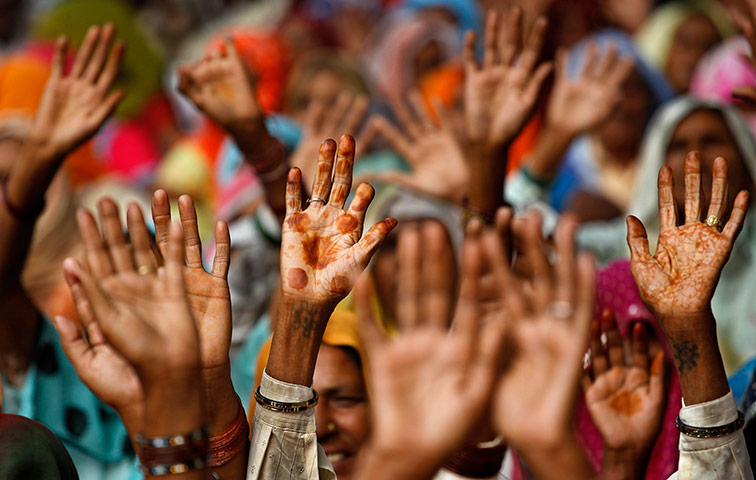
Women waving their hands in protest against a nuclear power plant.
Fotocred: Saurabh Das/A

Friday, 27 August 2010

UN #Fail ...Again

pic jacked from newsone.com

I recently finished assisting on an academic project on UN Security Council Resolution 1325 on the protection of women from violence and their involvement in peacekeep and conflict prevention processes. After it's unanimous declaration in 2000 in Windhoek, Namibia, the subsequent failure to implement by member states led to a further UNSCR 1820, 1888 and 1889 being passed with the aim of safeguarding women and girls from sexual and gender based violence. Needless to say these were meaningless diplomatic hand-wringing declarations that amounted to piffle.
Even in countries where UN peacekeepers were stationed, violations of women continued unabated, Liberia and the Congo are prime examples. Even in an instance where the UN had a mandate to act as country administrator, like in Kosovo, the rights of women were not protected by UNMIK (UN Mission in Kosovo) or any of the UN Resolutions. On numerous occassions, UN peacekeepers have been found guilty of taking sexual advantage of civilians, trading food for sex or raping civilians as young as 6 particularly in the Congo, Haiti and Sudan. 
The latest in the series of catastrophies is the mass rape of 150-200 Congolese women and children by rebel fighters in Kivu in a space of 4 days, just an hour away from the UN base. How did the UN fail to intervene? How did they not know? A UN official in DRC claimed that "there was no particular suggestion of an attack, much less the kind of events like the mass rape." Lies. Absolute lies. The UN was 20km away for crying out loud! In '09 UNIFEM released statistics showing that in Kivu 40 women are raped per day! And we're s'posed to believe there is no 'particular suggestion'??? The UN should admit it's failure, it's more dignified than trying to weasel one's way out of this. While the UN is not be responsbile for the barbaric rapes (yes we all know that is the work of Rwandan Hutu and Congolese rebels, for want of minerals and military conquest), the UN is responsible for failure to act on them. With a year to go before the UN peace troops pull out of Kivu, this goes down as yet another failed UN mission and proof that a complete, complete, complete (!) overhaul is needed within the UN, that experts like Thomas Weiss have been calling for, for the longest time. But instead all this will amount to is one more beautifully worded 'never again' apology to the victims of Kivu and another non-mandatory, conscience-cleansing Security Council Resolution.

Monday, 16 August 2010

Introducin'... Lindiwe Suttle


Been meaning to post this for the longest times, oops! This is Lindiwe Suttle, Felicia Mabuza-Suttle's daughter, and although I'm not a fan of her mother's talkshow (those from Southern Africa will know the Felicia show), Lindiwe - iLike! Oh so stylish (could jack her whole wardrobe!) n So so soulful, lookin' forward to samplin' her work & seein' her live one day.

Tuesday, 27 July 2010

Nneka on a Park Bench


Watch the full concert at baeblemusic.com


Nneka - Come With Me from david moffly on Vimeo.

iLove how this interview's done on a park bench in New 'Ork wiv Baeble Music.
It's so simple, yet so so good!
The first video is a bit funny the first minute, but it plays alright. 

In DOPE Music We Trust!

Wednesday, 23 June 2010

ARV Swallows: Positive Ladies


"They thought we were just playing games. They would laugh at us and say, ‘How can women play football? Will you be good at it? How can you sick people play soccer?" Meria Kabudura, winger.

A group of HIV women in one of Zimbabwe’s poorest areas decide to form a soccer team in order to compete in a tournament. They want to fight stigma by proving to everyone that they can win the tournament’s trophy.

There are 1000 copies of the film about these women up for grabs. If you would like a copy of the film, peep this link. The principle is watch and share, watch and share so it'd be great if you watch it and donate it to a library or community centre so as many people as possible get to watch it.

Tuesday, 18 May 2010

A Negroid Type


Carrie Mae Weems's haunting late twentieth- 
century images of naked and scarred black women and men have
their origins in a series of ‘slave daguerreotypes’ produced over one hundred and fifty years ago. In 1850, European scientist, Louis Agassiz,commissioned white American daguerreotypist, Joseph T. Zealy, to create fifteen views of seven slaves belonging to different tribal groups in Africa. These images are all that are now left of the lives of Alfred from the Foulah tribe, Jem from the Gullah, Fassena from the Mandingo and two sets of fathers and daughters, Jack and Drana from the Guinea and Renty and Delia from the Congo, all of whom were kidnapped or born into slavery in the American south. Mired in a nineteenth-century visual language of scientific racism, the black, white and grey textures of these original silver plates illuminate the lines, scars, bones and veins. of these women and men. Just as they provide intimate views of their physiognomies, musculature and genitalia, these images tell us nothing concerning the untold lives of these enslaved Africans.

extract from Introduction of African American Visual Arts, by Celeste-Marie Bernier
(a book worth reading for art crit types)
"My responsibility as an artist is to work, to sing for my supper, to make art, beautiful and powerful, that adds and reveals; to beautify the mess of a messy world, to heal the sick and feed the helpless; to shout bravely from the rooftops and storm barricaded doors and voice the specificity of our historical moment."
- Carrie Mae Weems

Farsi Denims

redseabluesea

pyjama coups and farsi denims
hang inside my closet
wedged between peace and revolution
for the bargain price of buyonegetonefree,
in the heat of june's power sales.

a color match strikes into a restless flame
of crushed denim and glitzy green scarves
dying the ocean red
giving it the texture of hardness
only the kiss of lead
can give.

it's a death only
beatnik mermaids vibin'
to breakbeats,
on oceanfloors
can resurrect.

and in this trance their
sequined swishing tails
can turn red seas back to blue.

copyright konwomyn 2009, to be published.

i wrote this almost a year ago when neda soltani died - yes the iranian girl even tho' the references are quite obscure. that's the whole point of poetry right - to be obscure, yet creative in your craft, not to the point that no one understands you, but with the right degree of mix of creativity and obscurity to reflect or make comment on how life is lived. dunno if it works here, but ay fashion makes a good metaphor. ; )