Showing posts with label Peoples. Show all posts

Wednesday, 29 June 2011

Blogging the Caine Prize: In the Spirit of McPhineas Lata

This is the fourth story in the series of Blogging the Caine Prize. Past posts can be found here. Indeed, the stories keep getting better with each passing week and unlike the others, Lauri Kubuitsile’s story (PDF) is a wonderful, funny tale that doesn’t perpetuate negative stereotypes, the writing is light and unrepetitive - yes, there is good and bad repetition in literature as I’ve noted before.

“In the Spirit of McPhineas Lata” is set in Nonkanyana village in Botswana about a deceased casanova, McPhineas Lata who, “though despised by most husbands ... was adored by most wives” and his funeral is “full of dramatic fainting and howls of grief echoing” from his many married female friends some doing their best to out mourn the other, by lying on his grave, as if it were a competition to show which of them loved McPhineas the most.
 

This story foregrounds the importance of memory when someone has passed on. The husbands fear that the wives’ desires to cling onto the memory of McPhineas will construct into a legend, an untouchable super-sex hero. As these memories are fused with the imagination, they become retold as altered representations of actual events that neither the teller or the subject - McPhineas - can ever recall so the memories become more spicy with the telling and re-telling of the women’s sexual escapades. Substitute the situation for any other and this is how ordinary people and nationalists create myth. The past then becomes a romanticized alteration of the past - with both good and bad effects, of course. 


Zunguzungu finds an interesting relation between sex, work and masculinity and suggests that because the men work long hours they are lousy in bed whereas McPhineas doesn’t work and is a great lover. I suppose his sex is his work - unpaid work - as he spends his days attending to the sexual needs of women. In presenting McPhineas as a ladies man and his encounters with them as an open secret within the community, it says something about the gender relations in this society. 


The men may be upset with McPhineas for being a better lover and what that means for their masculinity, but they don’t seem to object to their wives sleeping with him in the way a spouse might do. Why? I get that the story is meant to be that way, just a light-hearted story about the people of a funny little place but I want to think of this in a deeper way: whether this signifies any sort of empowerment for the women as it’s okay for them have extra-marital relationships and whether McPhineas helps maintain a balance between the genders. 

Historically speaking, is there a comparable McPhineas figure / practice in Tswana culture? And in a country where HIV is so prevalent (24.9% of 15-49 year olds are pregnant), what does it mean to have a McPhineas character who sleeps with all the women. Sure it’s great that there’s no sense of enforced monogamy in this community, but this kind of sexual freedom also has terminal limits in Botswana. And on that party pooper, note: The End.


This story is worth the read and if you’re interested in read the opinions of others here are a few thoughts from other co-bloggers:

Method to the Madness
The Oncoming Hope
Backlash Scott
Mumpsimus
Zunguzungu

Monday, 13 June 2011

Ending Sudan's Identity Crisis

Sudanese blogger, Amir Ahmadhad an op-ed on CiF last Friday on Sudan's identity politics and this is an excerpt from a longer and thought-provoking piece.

pic jacked from the internetz
Since a year before its independence in 1956, Sudan has witnessed terrible violence and bloodshed, which continues to this day. The reasons for this are numerous and complex, but one key culprit has always been our Afro-Arab identity crisis, which doesn't seem to have any near end in sight. 
Contrary to what many northern Sudanese may like to believe, the secession and independence of the south is not going to end the identity crisis, and it's certainly not going to magically turn the country into a genuinely Arab Islamic nation-state despite what Omar al-Bashir may want. 
It won't happen, not even by force, due to the simple fact that Sudan always has been and always will be a multi-ethnic, multi-religious melting pot. Multi-ethnic given its minorities and various dominant Arab, Afro-Arab and African tribes, and multi-religious given its diverse population of Muslims, Christians and animists. 
The question is: will we eventually have a democratic government that actually recognises and respects our diversity? Or will we continue to have an Islamist Afro-Arab regime, largely in denial of its "Africanness", which forcefully seeks to impose its self-serving interpretation of Islamic law and confused Arab identity on the rest of us? 
...We're Afro-Arab in three main ways, simplified as follows: 

1. Ethnically as well as culturally Afro-Arab2. Ethnically Afro-Arab but culturally predominantly Arab (the majority)3. Ethnically African but culturally predominantly Arab and hence "Arabised"  
Nevertheless, our attitudes don't really honour this reality. Yes, there are many of us who value our combined Afro-Arab heritage and self-identify, either as Afro-Arabs or just as Sudanese. There are also many who identify primarily as Arab or African for valid reasons that depend on which side of their cultural and ethnic heritage weighs more heavily. 
However, there are too many who reject their "Africanness" or "Arabness", with a few in both camps condescendingly and outspokenly showing disrespect for that aspect of themselves which they reject. Then there are those who don't reject, but rather gently distance themselves from their "Africanness" or "Arabness" – consciously or subconsciously.


TwoCents: I think the discussion extends to other parts of Africa - what does it mean be African, what does it mean to be Arab, and an Arab African or African Arab? And who defines what the dominant meanings of Arabness and Africanness is, what's the political relation and power balance? These are all contested and continually evolving identities and this is something Arab Africans and Africans (in all their diversities and colors), alike, need to have multiple, frank, cross-generational discussions about. 

Blogging the Caine Prize: Butterfly Dreams


This is a late post that should've been done on Friday (!), but real life got in the way, so here it is:


The second in the series of Blogging the Caine Prize is Butterfly Dreams by Beatrice Lamwaka from Uganda. She is published author and teacher and if interested you can read her story Vengeance of the Gods which was later turned into her first novel.


Butterfly Dreams is the story of a female rebel child soldier who comes back to her family after having been taken to fight by the Ugandan rebels in the conflict between the government of Uganda and the Lord’s Resistance Army (LRA) in Acholiland.

For me, Butterfly Dreams reads much better than Hitting Budapest - there's a bit more structure to the story and there's actual plot development. However, there's too much overwriting in the some parts of the story and as a reader I felt like there was a slightly tortuous dragging out of the story rather than  purposeful repetition where new facts or twisted metaphors are added. In some places the repetition works, because the writer actually does something with the words or she lets lets the story tell itself.

Compare and contrast:

Exhibit A:
We watched you silently. In return, you watched us in silence. We gave you food when we thought you were hungry. You gulped down the sweet potatoes and malakwang without saying a word. We didn’t want to treat you as if you were a stranger but in our hearts, we knew that you were new. We knew that you would never be the same again. We didn’t know what to expect of you.
Exhibit B:
This is something that we don’t understand. This is our home, something that we don’t know how to explain to you. Something we took refuge in. This is our home that keeps us alive. Keeps us sane. Just huts. Grass and bricks. Just huts to hide our nakedness.
Clearly B is much stronger than A because B actually describes refugee camp where they live and also explores the emotions of the family whereas A is, well, just words. And too many of the same ones, they don't move the story along but stagnate it. At points it comes across as an 'art for art's sake story' because it embraces certain stereotypes about Africa. What Neelika at Africa's a Country calls 'mining for misery.'

Unimpressed by the number of cliches in this story, The Oncoming Hope said in this very frank post:
name an African development storytelling cliché, this story's got it, from child soldier to displacement camps to walking to school though bombs to cartoonishly evil rebel soldiers.
Again I ask, if these are the stories the Caine Prize shortlists, what does that say about how the Caine Prize as a literary institution - with all the power it wields within African literature -sees Africa or expects to see Africa represented?

Backlash Scott had a more balanced, but equally critical view:
 the tone of the writing was what separated this piece from other “poverty porn” types of stories for me. Even then I’m kind of torn. The story is about a family’s struggle to cope with a crisis as much as it is about showing you how bad children have it in the North. While I would hardly expect a writer born in Gulu to shed the atmosphere in which she grew up, it is interesting to see how many of these Caine Prize stories will cater to the troubled-dark-continent narrative. 
...When reading this story I was reminded of the late great Yvonne Vera's Under the Tongue which similarly works on repetition and lyricism - only that Vera brilliantly executes it. Don't believe me, go read her. it also deals with muteness as a result of child trauma and the woman-centered family - Grandmother and mother - become the conduits through which the protagonist, Zhizha discovers a new language with which to speak, it is a language that isn't filled with the trauma of the past. Being taught to read by her mother becomes one way for Zhizha to regain her voice and another is through her Grandmother's stories of the family's history and in speaking, Grandmother exorcises the skeleton's of her past and also regains her right to speak as a woman because her husband had often told her 'a woman cannot speak'. Similarly in Lamwuka's story, the matriarchal family is the healing unit for the protagonist - hence the constant use of 'we' but it's used in a 'we and them' way rather  than an 'us' - as seen in the family dynamics discussed below. Education is also a form of catharsis for the child - but strangely also her obsession. Curiously before she is conscripted and after the war has begun she still goes to school: 
Even when the war started and many children were waylaid, you managed to get there. You cursed the teachers and called them cowards when you didn’t find any children or teachers. Days after a heavy fight between the rebels and soldiers you continued to go to school. You never gave up even when you didn’t find anybody there.
In the present-time of the story Lamunu's about 11 years old, so she was younger before she joined the war. Reading this I wondered how realistic is this, what parent would allow a child to go to school under such circumstances? I know it's fiction, but come on. There's got to be a level of credibility.

In her book, The Body in Pain Elaine Scarry explores the silencing effect of pain and trauma, it 'has a resistance to language' thus making it difficult for the traumatized to speak. So as much as the authorial voice of this story wants Lamunu to speak, she cannot. The pain is 'unshareable' and the only place of refuge is the special school where, through therapy she will speak again and have a new relation to language that will enable her to unburden the horrors of war. On the morning of her first day at school, she speaks:

You said apwoyo. You said thank you to Ma. That’s the first word we have heard you say. 
But the family responds: 
We’re happy to hear you say something. We hope that you will be able to say a lot more. Tell us more than Anena, Aya, Bongomin, Nyeko, Ayat, Lalam, Auma, Ocheng, Otim, Olam, Uma, Ateng, Akwero, Laker, Odong, Lanyero, Ladu, Timi…. Most of all, we want to hear your voice.
If the family still want to hear Lamunu's 'voice', then they are not listening. She has spoken by saying 'thank you.' It's a breakthrough! You'd think they'd make a song and dance about it, but they don't. Perhaps this is why Lamwaka's character finds sanctuary in an educational institution whereas Vera's protagonist finds refuge in her family who educate her and give her a 'new language.' In both of these stories the acts of expression could be described as a gendered performance of orality (oral + literature) as language is a pre-dominantly patriarchal construction and privilege and the wars in both Uganda and Zimbabwe are largely patriarchally-constructed struggles. Mmm okay, nice feminist jab there, I think I'll leave that issue now.

Onto the last bit, which I found really jarring:

Ma says that you will get special treatment. Most of the children are like you. They too have killed, tortured other children. They too fought in a war that they didn’t understand. The teachers will treat you well, Ma says. They have had special training.
'Most of the children are like you. They too have killed, tortured other children.' - From one sibling to another, eh? I get the feeling the family doesn't quite understand the new Lamunu or her condition and they don't seem to want to. Having already lost the father, lived in a refugee camp where they eat posho (a yellow maize meal like polenta that's often used as drought relief food in southern and parts of East Africa excl Kenya) that they used to feed the dog, they really aren't willing to deal with anymore tough emotional issues - they want to move on and be happy again. And they don't have the cultural capacity to do so, either:
"We had never been taught how to unbury a tipu. We only hoped that your real tipu was not six feet under."
For the family, any disruption would open the floodgates of tears and trauma they've tried so hard to keep shut, so Lamunu will have to go deal this at her 'school of the other children' and find her tipu

A list co-bloggers and their thoughts on this one:


Friday, 3 June 2011

postcard from rangoon...

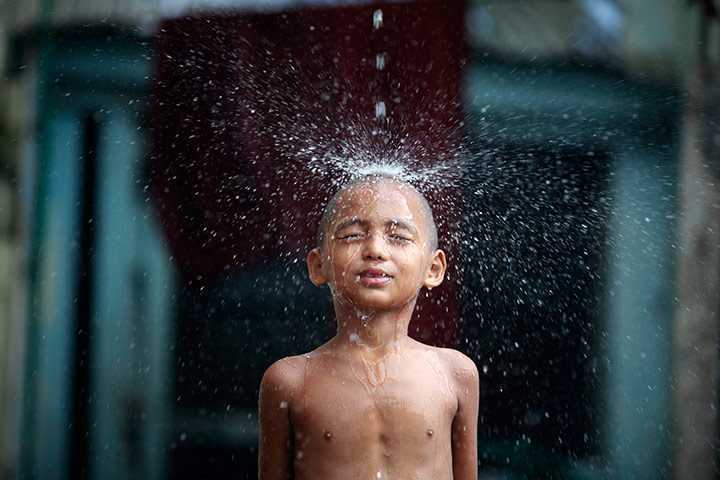
Rangoon, Burma: A novice Buddhist monk plays during heavy rainfall at the Shin Ohtama Tharya monastery
fotocredit: Soe Zeya Tun

Thursday, 2 June 2011

Slaving for Europe's Salads


While Germany's freaking out over the revenge of the killer 'cucumbers' (insert name of responsible vegetable when known), I thought it would be a good time to post this video from earlier this year. While countries may take steps to curb the spread of E-coli, will there ever be as much of an outcry over the living conditions of some of those who grow the continent's vegetables?

Wednesday, 1 June 2011

Congo: Two Stories, Two Lives


click cc for subtitles
fisttap afroeurope & tomdevriendt

Roland Gust was born to a Congolese mother and a Belgian father. He grew up in Congo, believing he was White. That is, until his family decided to return to Belgium when he was twelve. Twenty years later, he made a film about his life: The Belgian Colour Bar.

As long as I kept it to myself, there was no problem. Not for the outer world, that is. I remained Roland, the perfectly integrated coloured. I didn’t want to come across as a frustrated black man who was ungrateful for what Belgium offered him. I didn’t want to be expelled after so many years of trying, because I was begging for a recognition of my Belgian identity. I had to serve Belgium and remain silent.After all those years of absolute and blind dedication to the country of Belgium I have now crowned myself a Belgian. I have earned my place in Belgium and no longer need the Belgian’s approval to be a Belgian. As a Belgian I make use of my freedom of speech to tell my Belgian story. I no longer lie awake about the potential repercussions following my critical discourse about Belgium and the Belgian identity.

- From 5 Questions for Roland Gust by Tom Devriendt from Africa is a Country - The Belgian Color Bar


fisttap @telamigo (tomdevriendt)
Kwa Heri Mandima (kwaheri means goodbye in Swahili and Mandima is a village/growth point in DRC) by Robert Jan-Lacombe is a short, biographical exploration of his early life in the Congo. He never expected to say goodbye, but conflict made it so. Like The Color Bar above, this film explores similar issues of identity, belonging and non-belonging, race, memory, migration and displacement, albeit from a different perspective. It provides a good juxtaposition.

Zimbabwe's Mr Ugly


iThought this was an interesting story from Africa Review:

By KITSEPILE NYATHI in Harare
A Zimbabwean man who has endured being tormented by his bad looks, is now all joy. Mr Austin Mbewe,30, was crowned “Mr Ugly” after winning an unusual beauty pageant at the weekend. Mbewe walked away with $170 in prize money and a blanket when he was adjudged to be the ugliest by a panel of female judges.
“I feel honoured by this victory,” Mbewe told Zimbabwe's Herald newspaper. “I have been a subject of ridicule in society since childhood and the world has seen that there is beautiful side to my ugliness.”
Two Mr Ugly personalities were given $50 each and a blanket. All the finalists were also given blankets as consolation. The contest was held in Beitbridge, a town near the border with South Africa.
Lovemore Chonzi, the organiser of the competition, said it was “meant for people to have fun and celebrate who they are, just like any other contest in the world.”
The pageant had the blessings of the government controlled National Arts Council and the Zimbabwe Tourism Authority

Friday, 27 May 2011

Street Life in (Conrad's) Lagos


This documentary was recently aired on Al Jazeera on the programme Witness, a weekly show that aims to 'bring new stories to light they showcase the talents of a new breed of multi-skilled, frontline journalist.'  Street Life in Lagos is made by Joe Loncraine and it focusses on two migrants from Benin who go to Lagos, Nigeria in search of  a better life. As slum tourism is the in-thing among documentary filmmakers on African cities, this one fits right in. It raises the usual questions of who is telling Africa's story, how and why? How are these Africans telling their story within this documentary, what is it's framing? How is Lagos the city, it's slums and it's inhabitants represented on screen? By the looks of things, not very well. Unlike some of the commenters on AJE's site or the upset multitudes on Nairaland, I think it's really great that these stories are being told and I have no problem with Nigeria or any other country's poor being given a platform to speak. However, when it becomes fashionable for the world's media to tell only one particular kind of story about a city and this becomes the perceieved major, singular narrative of a city, I think it becomes probelmatic and especially so when that narrative (with all due respect to the filmmaker) isn't presented well. A city has many complex, interwoven stories.

The act of giving of voice to stories -by making a film, writing a news article - is as crucial as the telling because the framing, context and intent etc is what also (not solely) gives meaning to a story, determines audience reception and what genre the story falls into. This feels like a cross between observational anthropology and poverty porn, because, despite the filmmaker's most likely good intentions, the film doesn't create a bond with Makoko or many of its people seen throughout the film - they're fleeting, sometimes dragging stories, but the glue that binds a viewer to a character/story somehow isn't there. It feels like you're meant to just get a glimpse and move on. In the role of anthropologist armed with a camera, the filmmaker gives no introduction nor political or social context to Makoko or Lagos - instead the (international) viewer is thrown in the deep end. As a documentary film concept it might be all edgy and stuff, but unfortunately it doesn't work here. 

After the protagonists have told their stories of migration, the anthropologist/filmmaker goes to the school (around 4:00) where poor, non-speaking, inquisitive children are filmed. No explanation nothing, onto the next scene. And so it goes: lots of stories belonging to nameless, ageless people whose characters and circumstance you never really get to know... If Wole Soyinka was outraged by BBC's documentary, Welcome to Lagos, I can't imagine how he'll respond to this. It's a million times worse. And unlike the BBC's one which had the sickest afrobeat soundtrack, this one doesn't have much of that. Instead it invites us to observe (not engage with) the poor slum dwellers of Lagos, all filmed from behind a Conradesque camera lens.


Wednesday, 25 May 2011

I Am An African


I believe this extends to all of Africa: North, East, West, Central and Southern,
Happy Africa Day.

The Global Peace Index


Vision of Humanity has produced this year's global peace rankings. Not sure how this functions as a 2011 index when we're not even half-way through the year and things could look so different by October in places like Tunisia and Egypt (elections) and Southern Sudan could officially be a new country...or not. Depending on what happens in Abyei. From what I can see there seems to be no information on a number of small countries: Lesotho, Lichtenstein, Monaco, Benin, the Seychelles, Reunion Island, Cape Verde, Suriname, Djibouti, Mauritius and Western Sahara. Interesting to note how much the protests in the Arab World have influenced unrest elsewhere, but its still an unfolding story and so I'm not sure how far that can be used as a reliable measure for 2011.  Also, countries like Cote d'Ivoire and Nigeria, in different transition stages from violence to stability so they too could look very different in another six months. I doubt whether Spain's protests were included here. Israel won't be too pleased to be 145 - eighth place from last, neither will America be happy at number 82 - below China at 80.  Zimbabwe's 140 - no big surprises there. I think we're now used to being ranked near the worst or not ranked at all in these things. 

But still this is a very, very useful resource, especially when looking at the economic and political factors (like press freedom, GDP, gender equality, internal and external conflict etc). These are used to indicate peace levels and these are also some of the motivating factors for the popular unrest seen in places like Burkina Faso, Egypt, Tunisia, Yemen etc. (As we all know) For these people-led movements it's not only about toppling an oppressive regime, but people also want to build better, more peaceful and more equitable societies.

There's more information on the site,but here's the summary of findings from Vision of Humanity:
  • The world is less peaceful for the third straight year
  • Due to an increased threat of terrorist attacks in 29 nations
  • A greater likelihood of violent demonstrations in 33 countries
  • Arab Spring unrest heralds biggest ever change in rankings, Libya tumbles 83 spots
  • Iceland bounces back from economic woes to top ranking
  • Somalia displaces Iraq as world’s least peaceful nation
  • Violence cost the global economy more than $8.12 trillion in 2010
  • US peacefulness shows minimal change

Saturday, 21 May 2011

For the River


This song by Ghanaian artist, Wanlov the Kubolor, is part of a clean water campaign begun by the artist in a bid to tackle pollution in Ghana. Here he sings about the problems faced when rivers carry the Ebola virus or are polluted with toxic chemical or electronic waste. This song is inspired by Bathe in the River by New Zealander, Hollie Smith, a big soulful tune which spent 22 weeks in New Zealand's top ten singles charts in 2006. Wanlov's video has been chosen to headline the Environmental Film Festival of Accra from June 7 to 19. For those in Europe, look out for Wanlov in your city when he goes on tour later this June. Some of the scheduled concert dates are: 3 June Würzburg, 5 June Rome, 7 June London, 10 June Iaşi and 12 June Angoulême. Follow him on twitter (@wanlov) for more info.

Also, worth reading is the article in Arise Magazine in which they speak to Wanlov about his pidgin rapping and social consciousness.
About his activism he says:

“I’d say I’m a social-consciousness rapper, but that’s so restrictive because then I go and do a song about some lady’s ass. I like to clown. I sometimes reflect on bad things that are going on but I don’t do foreboding.


...Last year I did a barefooted walk against poverty. A human-rights group asked if I would lead the procession. At that time some major oil contracts were being signed so we were doing the walk to raise awareness about how things went down in Nigeria.


...When I write, things that bother me – slums, sanitation, wars, climate – come out too. My second album was soccer-themed but there were messages. At that time there were many scandals going on; a minister had taken government funds and thrown a party. For people who know what’s going on politically, the cover sleeve is interesting [because it’s a cartoon satire of current scandals].


I’m more into the environment. Pollution bothers me. And I don’t like seeing villages all branded. The whole country is branded in mobile phone colours. Every roundabout or monument is branded by some company. “Pidgin slang is the language that everyone from the shoe-shine boy to the vice president uses with their friends. With pidgin, people start picking out stronger terms, words that sound cooler, and they keep building. 
For some reason there is this inferiority complex where people want to hide their language. I feel it is important that people are comfortable in their skin and environment, because otherwise everybody will become the same. Things will become bland.
I’m being courted by the World Bank. People say the World Bank is strangling Africa and so on, but we strangle ourselves most of the time. If that money is appropriated correctly, it will make things happen.”

Together We Can Build?


This was the ANC's local elections campaign song by kwaito artist, Chomee (video complete with guest appearance from the King of Kwaito, Arthur Mofokate). It's an ironic considering that the ANC failing in public service delivery from decent housing to toilets to electricity and water services.  Here's an extract from a very powerful piece Bastards of a Dream Deferred by Lindokuhle Nkosi (recommended reading). Although it was published a few days before the election - it's still relevant and it provides a sobering contrast to the happy clappy, shuckin' n jivin' video above. 
(sidenote: Compare and contrast Beyonce's dance routine for 'Who runs the world' with this, clearly Bey's moves come from South Africa.)


“We have no water, we have no electricity. The ANC is killing us man. They killed my father. They took my legs.” I want to tell him that alcohol took his father. I want to tell him he lost his legs when the Military truck that he and his drunk soldier friends were in hit a pothole and flipped. Instead, I focus my energies on funneling the boiling water into three small teacups, whilst watching that he doesn’t steal anything to trade for alcohol, like he did last time. I’m cold and hungry. I’m thinking about the slow puncture I got trying to avoid a mound of cement the community had placed in the road when they realised the government would never get around to building speed humps outside the school. The pot slips, water spills on the coals putting out the fire that had been burning for three days now. No worries, the gas stove has arrived, and I managed not to burn myself.

I place the tray on the table next to a few lit candles. The same table my frightened cousins and I huddled under a long time ago, hiding from the police and red-clad Inkatha impis who marched down the street armed with pangas and hatred. “It would get better,” the older ones would say. The country would be free, my uncle would come back from exile. One day, we’d share in the freedoms that were currently only a privilege of the paler skinned South Africans. But there’s no electricity, and the water has been on and off since December, and I still need to change my tire. They say the sub-station burnt. The broken dreams made love to the empty promises and ignited a baptism of fire. The decaying bodies of the poor and the black blocked the pipes and the water can not flow. The desolate tears choke the voice of the oppressed and their cries will not be heard.
Jacob Zuma’s face smiles audaciously off a streetlamp that has never, in my memory, been operational. “Vote ANC!” He grins. “Together we can do more…” A tall vandal has scribbled something in black marker over the ellipses. The campaign poster now reads: “Together, we can do more crime.

Monday, 16 May 2011

Why Rape?


fisttap @texasinafrica

Howard French asks about some thought provoking questions on the recent report on rape statistics in the Congo about how the Congo is constructed in the media and our rather limp global response to the ongoing war which has killed well over five million people to date. I think it's interesting to consider French's critique alongside this extract on the Congo from a longer, interesting piece about the lack of media attention to the protests in Burkina Faso recently published in Pambazuka:
The Guardian's 2010 list of most tagged countries confirms to some extent that history of familiarity with a place guarantees coverage. Egypt, South Africa and Zimbabwe got tagged more times than the DRC (Democratic Republic of Congo) and Sudan. Possibly because of its hosting of the World Cup, South Africa had 547 tags, outranking earthquake-stricken Haiti, which had 436 tags. Egypt had 219, while Zimbabwe had 144 tags, and yet the DRC had a paltry 124 tags, Sudan had 122 and Somalia even less at 113. All three are among the most unstable African countries of 2010 and yet they ranked lower than the World Cup host South Africa. The war-stricken Congo is one of the world's suppliers of raw materials for mobile and computer technology and ironically constitutes just over a fifth of the 604 articles on Apple. This is not a criticism of the Guardian as the paper does provide some of the best and insightful international news coverage, but these tags are unfortunately a skewed quantitative reflection of coverage patterns and the consumerist nature of public interest.
Saying this with all flippancy intended, the formula is simple. Reports of anti-British and homophobic comments by the African dictator everyone loves to hate, and shark attacks in Sharm el-Sheik make catchy headlines. Never-ending sagas of jungle wars and mass rapes, unless involving powerful countries, do not. Or unless they're packaged as humanitarian causes fronted by celebrities and award-winning journalists like George Clooney and Nicholas Kristof. Their combined interest in the Save Darfur campaign, malaria awareness and referendum for north–south separation ensured Sudan received frequent coverage in the New York Times. Unfortunately, no similar twin-set of movie star and scribe of Clooney's and Kristof's stature have permanently adopted the DR Congo or Somalia as their primary cause. Although one of the aims of international news is to appeal to as broad a global audience as possible, how broad is our interest and genuine our humanity as people if we suffer war and compassion fatigue towards stories on the DRC, Somalia and Sudan?

But now with all these revolutions and uprisings going on, places like the DR Congo are a distant tragedy. Despite the exceedingly valuable coverage of the uprisings by some news networks, there is an underlying sense of competition within the media to see who can land the best, exclusive interview or provide the most comprehensive coverage. In the face of such fierce competition, taking a few moments in between protest broadcasts to ask the world to remember the 5.4 million (and rising) Congolese dead since 1998 or to take a serious look at Compaoré's megalomanic scheming in Burkina Faso wouldn't be a suicidal gamble with the ratings. Events in Africa and the Middle East shouldn't be placed in competition with each other; what's happening in Nigeria, Syria or Libya can share the spotlight with many other untold or under-reported stories. It’s a question of willingness to pluralise news stories and cover unfamiliar terrain.
Joy Dibenedetto, a broadcast executive and founder of alternative news site, Hum News, reports that in 2009 research conducted by Hum News found that there are 237 countries or territories in the world, and the world's largest news organisations report from only 121 countries or territories. Out of 237 global locations, 116 are not covered. If true, that's just under 50 per cent of the world's stories potentially out of mainstream media focus – almost 50 per cent. Allow that to sink in.

Tuesday, 10 May 2011

New Navy


New Navy are a indy band based in Australia and this is their debut song 'Zimbabwe'. The video  was released yesterday and their album, 'Uluwatu' is due to be released at the end of May. Having previously reached number one on the Tripple J Unearthed charts (discovers new bands in Australia) with their song Animals, this track looks set to take their name beyond Australia. New Navy have also performed with or opened for Cassette Kids (Google them, plse!) and Wolfmother among many others. 

In DOPE Music WE Trust.

Friday, 6 May 2011

Shake the Dust


The amazing clip above is a preview from an upcoming documentary, “Shake the Dust which features hip hoppers from all over the world. Made by emerging film director Adam Sjoberg, the film tells the story of b-boys, and girls in poor communities from Uganda to Yemen to Haiti who all connect through the universal language of hip hop. Acknowledging the universality of music, Sjoberg writes of hip hop culture:
"although separated by cultural boundaries and individual struggles, are intrinsically tied to one another through their passion for break-dancing and hip-hop culture....“Shake the Dust” uses b-boying to show commonality and humanity in cultures that are affected by war, disease, and poverty. It seeks to paint a picture of the struggles the characters have– but only as a backdrop to the real story: one of hope and beauty."
Interestingly, there's a side story that developed out of making "Shake the Dust" in Yemen Sjoberg met up with some Somali hip hoppers who dropped some rhymes about the futility of war, their ancestry and forced migration.


For more on Yemen's b-boy crews, I recommend Tom Finn's article, on Sana'a's breakdancers. Apart from insight into how hip hop as universal livelihood and source of creativity for Yemen's youth, the different class mix and multi-cultural dancers stood out for me. The main group featured in this article is The Blast Boyz who are described as "a motley bunch of refugees and expatriates, harking from Canada, Tanzania, Iran, Somalia and America." This is an important thing to remember at a time when there's so much political focus on Yemen. It is often presented as a monocultural and monracial society and yet Yemen like many other Arab countries is visibly multicultural and thousands of years of interaction with countries on the Horn of Africa. Depending on what you believe, modern humans are said to have migrated out of Africa through Yemen and milleniums later, the Ethiopian Queen of Sheba (Makeda) ruled over the then south Arabia and parts of the East Africa. Presently there are at least 700 000 Somalis in Yemen as its one of the closest countries for people fleeing conflict or seeking a better life. Obviously, migrants are in the minority (23 million pop.), but they're some of the small everyday stories which are part of the current, mass anti-government protests which will hopefully topple Ali Abdullah Saleh. On the impact of the protests on hip hop and family life, Finn writes:
"Social stigma, the b-boys say, is the only thing stopping them from joining the ranks of protesters who have been camped outside Sana’a University for the past two months calling for Yemen’s ruler for the past thirty-three years, President Ali Abudallah Saleh, and his family to leave power. “My father would disown me, simple as that,” says Danny Al-Basry, another Iraqi considered one of the crew’s most talented members. “But if things get much worse here, I will have to join them.”
Like many others, the boys say they feel alienated by social expectations that are no longer achievable as a result of the deteriorating economic and political situation. For some of them, b-boying is not only a means of expression but also a vital way of escaping from these looming pressures as well as the monotony and tedium of everyday life in Yemen."

b-boy in yemen
fotocred: adam sjoberg
jacked from www.jonatascouto.com
fisttap @tomwfinn


Tuesday, 3 May 2011

Late Notes on Swaziland II


A friend sent me this this op-ed on Swaziland and these are the opening lines:


"Swaziland – a bewitching, verdant and mountainous little kingdom in southern Africa – has lately been more troubled than usual."


Like a red rag to bull this sentence has all the Conrad-esque lazy stereotypes that would be written by 'Westeners' of Africa. But its not written by a Westerner, but someone in Swaziland and it was published by the revolutionary Al Jazeera. At least there's a nice little disclaimer at the bottom of this commentary, otherwise this wouldn't reflect well on AJE. If you carry on reading its one depressing, negative statement after another. To be honest, this kind of thing belongs on the BBC or New York Times who've mastered the art of producing depressing narratives on Africa. Don't believe me - search through their 2001-2009 articles on Zimbabwe and there are archives of 'Zimbabwe the basket case' analogies. This on Swaziland, belongs there.
Future opinionistas on Africa, please consult Binyawanga Wainana's How To Write About Africa before writing.

Thursday, 21 April 2011

Dadaab: The City that Shouldn't Exist (?)


fisttap texasinafrica
As if to conicide with other (month-long) events commemorating the 20th anniversary of Dadaab Refugee Camp, the world's largest and oldest refugee camp on the Kenya-Somali border, the Danish Refugee Agency launched this Facebook game. First named 'The Worst Vacation Ever', some clever creative renamed it 'The City that Should Never Have Existed' - much better right? Not quite. According to Reuters Africa News Blog, the game was "pulled from the internet just days after the launch amid claims that it is in bad taste and dehumanizes refugees." 

Descrbing the game, Reuters reports, 
It’s a race against time to “drag” refugees to three safe areas in the camp (cue applause) before vital resources run out and refugees are reduced to piles of bones.
Bizarrely, the Facebook poster for the game shows what looks like a World War Two-era bomber flying over a fort emblazoned with the ECHO logo and surrounded by aid tents.
“How do I win?” someone calling himself “Sirak Prince” and claiming to be from near-by Kakuma refugee camp wrote on ECHO’s Facebook page. “Visiting Dadab from Kakuma is like Bagdahd from Mogadisho ! (sic) Hell we need new safer life not new fake projects!”
Overcrowding, lack of sanitation, poor shelter and sweltering heat make the 20-year-old Dadaab camp renowned for health hazards, insecurity and general squalor.
Julie Laduron, ECHO’s communications officer, confirmed that the European humanitarian body had removed the game from its Facebook page and main site on Thursday, by which time it had attracted 139 “likes”.
“Of course everyone has some different sensibilities about the game so for the moment it is suspended,” she said.
Despite suspension of the game there are those working in the refugee sector who felt this dumb idea was actually a good idea:

Anders Knudsen, DRC campaign coordinator,
“We want to reach young people and that cannot be done through reports, policy statements and information videos,” Knudsen said. “With this campaign, we meet the young people through their own media."
 
Rob Schofield, disaster management director at TearFund,  
"We think the game is a great way of introducing young people to the realities of humanitarian work.”
Jan Kellett, programme leader at aid watchdog Global Humanitarian Assistance,“The game is sort of positioned right for what it is trying to do,” he said. “It’s not very complex but it does show the challenge of matching resources to people.” 

Sorry but no. If you want to create a game that gives young people a sense of what humanitarian work is about, you do it with dignity, after all human beings are the central subject of this game created by humanitarians. Dadaab is not some extreme game or dangerously exotic place for the young mind's consumption; its an actual place where people live not out of choice, but because a brutal unending conflict has made it so. There is a deeply entrenched perception of Somalia as hell-on-earth and while many humanitarian agencies and refugee have tried to deconstruct that myth, games like give credence to it. Not that there's anything wrong with games about refugee camps, just not this sort of thing.

Monday, 18 April 2011

Tozeza Baba


Still in Independence Day mode, I'm sitting here wishing the whole world understood Shona so I could post a playlist of all the songs I'm listening to right now. But since that's an impossible wish, I'll post one song by Oliver Mtukudzi (Tuku). It's called 'Tozeza Baba', meaning 'we are afraid of father' because the father's a drunk who beats up on the mother, as the video shows. It's also a chastening of the father by a child as Tuku's first line is 'Imi Baba imi manyanya' meaning 'you father you, you're overdoing it now.' (*insert finger wagging here*)
Depending on how much you read into Tuku's music, there's also a subversive political meaning to the song. Substitute the domestic setting for the national and this could describe the situation of the country, a nation with a political Father who unnecessarily exerts his authority on the weak and vulnerable. The genius about Tuku is that he has never openly expressed his political beliefs in his music, the listener is free to interpret his music in whatever way they wish. Both of the main political parties in Zimbabwe, Zanu and MDC, have appropriated his music because he has played at Zanu rallies so some say it suggests he supports the brand anti-colonial nationalism of Mugabe whereas the latter interpret Tuku's songs to be an anti-violence, pro-change stance, especially because of Bvuma (not the best videos) a controversial song urging someone to accept that he has gotten too old and must make way for young...

On the controversy surrounding Bvuma in 2000 (?) (year of the fast-track land re-appropriation scheme):
There was also the case of a sound engineer who worked for Oliver Mutukudzi who was apprehended after a live performance where it is said that he directed a stage light on Mugabe’s portrait when Tuku was tuning out his banned 'Bvuma' a song that has been interpreted as directed to Mugabe.
Artists such as Mutukudzi and [Thomas] Mapfumo command a huge following and their lyrical composition has always been under the spotlight. The government tried to pin down Mutukudzi for his song 'Bvuma' and he gave an excuse that he did not direct the song at the head of state. Actually it referred to his relationship with his children. Mutukudzi has been on record for making it clear that he is not a ZANU PF supporter after a series of botched attempts to align him and his music with the ruling party.
Source: Freemuse

31 Today, Makorokoto Zimbabwe


Zimbabwe turned 31 today and I decided to return to blogging after an extended break. To acknowledge, Zimbabwe's Day it was a toss-up between an inspirational song or something historic (as I did last year) but Independence Day signifies many things. It is not only a day of revolution, but also a day of celebration, so I chose a song of upliftment. It was a tough choice between 'Pane Rudo' (There is Love) by ExQue featuring the legendary Oliver Mtukudzi
and 'Mugarandoga' / Loneliness by DK Republic (posted below), but I settled on the above as the main track to partly convey how I feel today. The one below probably expresses the feelings of millions in the diaspora who for many, complex reasons left Zimbabwe.
The song is called Shaina meaning shine and its a collaboration between two well-known Zimbabwean singers; Alexio Kawara and Andy Brown. As the song title suggests, the song is about making it through the trials of life and shining like the sun after a storm. Never give up and never allow yourself to crumble because you never know what lies ahead, so despite the darkness, you are a star and you must shine, don't let your light go out Zimbabwe, happy birthday.