Showing posts with label Kenya. Show all posts

Thursday, 26 May 2011

From Obama to O'bama

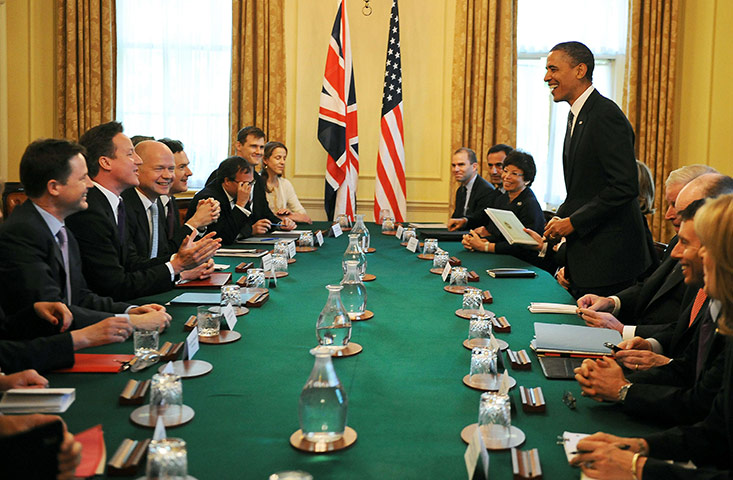
Barack Obama takes a seat for an expanded bilateral meeting with David Cameron and other delegates in the cabinet room
fotocredit: Jewel Samad/AFP/Getty
jacked from the Graun

Yesterday Barack Obama addressed both the Houses of Parliament (not this pic) as part of his tour to Europe. David Miliband, former Foreign Secretary, now MP of South Shields tweeted:
"Obama speech came alive talking about diverse societies. But not one non-white person on British establishment side of stage."
Though Miliband is part of the very political establishment he derides, this tweet hit home. It's been really weird, surreal even, watching Britain's political elites and media fawn over the Obamas. On Monday Obama was in Ireland visiting the village where his great great great maternal grandfather is said to have come from. And so Obama, or rather O'bama is now an Irishman. To prove it, the Guardian printed an opinion piece with a headline declaring 'Obama finds his inner Irishman.' And the Irish Times ran an interesting commentary by Gavin O'Malley on the political history of the Irish and Black American communities:
"the African American community responded by providing the votes needed to elect the first Irish Catholic president [John F. Kennedy]. The course of history changed. Black merged green and green merged black. Irish-Americans and African-Americans dropped their hyphens... and once again became one."
For those who don't know much, it's informative, but it tends to recall only the good bits about Ireland's past and seems to leave out the bad bits. Seemingly, its o'kay to leave those bits out, as the most of the UK media has done, because on this occasion it's about celebrating the visit of O'bama the 'Irish' President of America. Balance and a more critical approach, would have been a little embarrassing because as there's been plenty of solidarity, there's also been plenty of oppression too. And though present-day Ireland and America certainly paints a better picture of oneness and a people bound by a common identity, it feels strange, but positive, but also weird to watch O'bama being welcomed with a pint of Guinness and a name change. 


Even more awkward was Wednesday. Obama gave a speech in Westminster during which he mentioned his paternal grandfather: 
"It is possible for the sons and daughters of former colonies to sit here as members of this great parliament and for the grandson of a Kenyan who served as a cook in the British army to stand before you as president of the United States,"
Indeed Obama has proved it is possible for the grandson of a Kenyan cook to become President of USA, but the rapturous applause he got shows the bi-polar nature of parliament - which as David Miliband's tweet above notes, is quite unrepresentative. This is the same institution trying to wriggle out of compensating the Kenyans tortured under British colonial rule because the government is not responsible for what happened in its colonies. Obama ever the diplomat, didn't mention how cruelly the British treated his grandfather, a subject he oddly never mentions much. It's odd that, apart from Libya, the highlights of Obama's speech and general tone has been one of acknowledging migrant histories and the benefits of multiculturalism and yet this government believes in 'muscular multiculturalism' and ridiculously proposes no right of appeal on visa rejections. And now that immigration figures have just been released showing an increase in migrants coming on, one can expect to see the right hit the panic button and call for tougher immigration controls. So what was parliament clapping for or was it just the lily-livered lefties?

Thursday, 21 April 2011

Dadaab: The City that Shouldn't Exist (?)


fisttap texasinafrica
As if to conicide with other (month-long) events commemorating the 20th anniversary of Dadaab Refugee Camp, the world's largest and oldest refugee camp on the Kenya-Somali border, the Danish Refugee Agency launched this Facebook game. First named 'The Worst Vacation Ever', some clever creative renamed it 'The City that Should Never Have Existed' - much better right? Not quite. According to Reuters Africa News Blog, the game was "pulled from the internet just days after the launch amid claims that it is in bad taste and dehumanizes refugees." 

Descrbing the game, Reuters reports, 
It’s a race against time to “drag” refugees to three safe areas in the camp (cue applause) before vital resources run out and refugees are reduced to piles of bones.
Bizarrely, the Facebook poster for the game shows what looks like a World War Two-era bomber flying over a fort emblazoned with the ECHO logo and surrounded by aid tents.
“How do I win?” someone calling himself “Sirak Prince” and claiming to be from near-by Kakuma refugee camp wrote on ECHO’s Facebook page. “Visiting Dadab from Kakuma is like Bagdahd from Mogadisho ! (sic) Hell we need new safer life not new fake projects!”
Overcrowding, lack of sanitation, poor shelter and sweltering heat make the 20-year-old Dadaab camp renowned for health hazards, insecurity and general squalor.
Julie Laduron, ECHO’s communications officer, confirmed that the European humanitarian body had removed the game from its Facebook page and main site on Thursday, by which time it had attracted 139 “likes”.
“Of course everyone has some different sensibilities about the game so for the moment it is suspended,” she said.
Despite suspension of the game there are those working in the refugee sector who felt this dumb idea was actually a good idea:

Anders Knudsen, DRC campaign coordinator,
“We want to reach young people and that cannot be done through reports, policy statements and information videos,” Knudsen said. “With this campaign, we meet the young people through their own media."
 
Rob Schofield, disaster management director at TearFund,  
"We think the game is a great way of introducing young people to the realities of humanitarian work.”
Jan Kellett, programme leader at aid watchdog Global Humanitarian Assistance,“The game is sort of positioned right for what it is trying to do,” he said. “It’s not very complex but it does show the challenge of matching resources to people.” 

Sorry but no. If you want to create a game that gives young people a sense of what humanitarian work is about, you do it with dignity, after all human beings are the central subject of this game created by humanitarians. Dadaab is not some extreme game or dangerously exotic place for the young mind's consumption; its an actual place where people live not out of choice, but because a brutal unending conflict has made it so. There is a deeply entrenched perception of Somalia as hell-on-earth and while many humanitarian agencies and refugee have tried to deconstruct that myth, games like give credence to it. Not that there's anything wrong with games about refugee camps, just not this sort of thing.

Friday, 21 January 2011

postcard from lamu...

Lamu, Kenya
jacked from mahala.co.za
fotocredit: Sydelle Willow Smith

Friday, 17 December 2010

postcard from the chalbi desert...

The Gabbra are part of the Oromo people who live as camel-herding nomads, mainly in the Chalbi desert on the border between northern Kenya and the highlands of southern Ethiopia.
FotoCredit: Beeno Neeleman


Friday, 26 November 2010

The Most Beautiful, The Most Moving, The Most Truthful, The Most Relevant Video of All Time for All Young People Everywhere


fisttap africasacountry

This video is truth. Accept no substitutes. It is a truth that applies to every single person out there, not just in Kenya but in every country in the world. The more apathetic and indifferent we are as tenant citizens, waiting for freedom to fall as manna from the heavens, the more leaders will abuse power and steal from the country in any way they can whether it's bad investments (Iceland), overspending (Ireland), cooking the books (Greece), containing people within a small territory (Israel), clan wars (Somalia), imprisoning the most number of young people in the world (America), fighting illegal wars (NATO), interfering with broadcasting services and scrambling messages (Argentina, China) or imperialistically funding military ventures while public health services and education grants are cut (UK). All of these actions impact on us, and this video touches on how how our inaction, as tomorrow's generation of leaders allows evil to continue. Although this video was made by young Kenyans to encourage other young Kenyans to vote, the genius of this message is that it is universal and it is timeless. It is not only about putting or not putting an 'x' on a piece of paper, it's about actively taking responsibility for the future, particularly for apathetic educated, younger generation who see politics as nothing to do with them or are so disillusioned with the state of things that they don't care any more. 
#deathtoapathy
#deathtorunningaway
#deathtoarmchairpolitics

Featuring a random sampling of Kenyans. Directed by Mbithi Masya and Jim Chuchu for Kuweni Serious. Edited by Mbithi Masya. Narration by Bill Sellanga, words and music by Jim Chuchu.
There is a difference between the one who rents a house, and the one who owns a house. The one who rents a house doesn’t care if the walls crack and crumble, they can always move to another house.
The one who owns a house knows that no one else will take care of it, thus they paint the walls and mend the cracks. More than 60% of Kenya’s population consists of young men and women like us.
The problem is that we behave like tenants of Kenya. We have let the older generation tear this country apart. We have let them use us to fight their battles. We have let them loot this country. We have let them fool us into thinking that we’re not fit to run this country ourselves.
So we hide in our alcohol, in our religions and on the Internet as if there is some other Kenya out there that we shall move to when this one crumbles. We sit at home and wait for others to fight for us on the streets.
We want green cards instead of voter’s cards. We are angry, but we are too scared to do anything about it. It is not Obama’s job to save this country. It is not the donors’ job, and the government has shown that it is not their job, either. Responsibility is not shared, it is earned.
Freedom is not given, it is taken. When we decide we want freedom, we will have to get it ourselves.
Because if this country burns, we burn with it.

Thursday, 23 September 2010

Ultimate Walk for Humanity

pic by Yasser Booley
by Kim Winter
Miyere ole Miyandazi was born in Nakuru, Kenya. He is a Maasai Warrior and social activist. His journey, uniting fellow activists, artists and friends is called the Maasai Mission and the Ultimate Walk for Humanity. Miyere left Kenya in 2004 travelling by foot to Cape Town and is currently planning on walking back up to Cairo.

Mahala: Miyere, you said you have been working on the Ultimate Walk for Humanity this weekend – Are you busy raising money at the moment?
Miyere: It is not really about money or extending a hand or bowl of begging. It’s about awareness. Money has never done anything for the continent, for the people. It changed nothing. Consciousness needs to change because this is where we see a lot of corruption.
So, is the Ultimate Walk for Humanity purely based on raising awareness?
We aren’t rehearsing our life’s journey. But have we been walking it consciously? And what will be the result? Consciousness is waking up. All around the world. How do we harness that, how do we become partners?
The resentment in our souls makes us fear each other but the time has come now for the Ultimate Walk. Look around, look at the recession, we know for sure these thing are not new, they divide people.
Ok, lets go to the beginning Miyere, how did you come to be in South Africa?
When I talk about the Ultimate Walk and the Maasai Mission, and breaking down the boundaries that divide us, those imposed barriers, it includes names. I don’t believe there is a country called South Africa. I really don’t.
How can we break down barriers based on prejudice? These boundaries were made by people making these decisions without thinking about the impact. And that is why we see what is happening on the continent today. So me coming down here was really to learn but also about inviting the world to see how we are being subjected to abuses that are not being exposed.
Cape Town was my first stop. This was the first phase of the mission – get as many contacts as possible, co-operate with other activists and be where parliament is. The main reason was to highlight the plight of the minority people from East Africa and especially the Maasai people…
You said that building connections was the first phase, so what’s the next phase of your mission?
To expose the fact that minorities are not being allowed to lead their own unique journeys.
Which different minority groups have you worked with here in South Africa?
We have worked with the Bushmen in the Kalahari and formed a lot of different forums within communities. Here in Durban we’ve been working with the Zulu people over land issues.
I’ve been working with street children, who are really a minority. Using the Maasai vision to honour these children and give them a chance to regain their dignity.
NGOs mostly rely on foreign support which is not sustainable once that foreign support pulls out. This goes back to the beginning about money. The first way to solve a problem in a community is to look at the community itself. We have a long way to go.
So, it is an issue of empowering people to empower themselves?
Yes, but the thing is we are already empowered. We have each other. We have land, water, air, and we can make fire. We have these elements of life. But it’s about land. That freedom to move as your ancestors did.
We need to liberate people into understanding the value of what they already have. It is sad to see African people selling their land and going to work in Europe because they can make money. I can’t understand this. You are leaving your land which is a part of you. Going somewhere you can’t even own land or grow your own things. Where you have to depend on supermarkets.
I trace back troubles we see today to the partitioning of the continent. If we continue to invest in these borders that we cannot define, it’s blood.
What is your vision for the Ultimate Walk for Humanity?
We are walking from the Cape to Cairo. Saying that Africa is home to everyone. With this journey I’m hoping the world will come back home and get ancestral blessings! We are not finding each other, just seeing reasons to fight. Manufacturing arms everyday. Making fences and separating each other.
The Ultimate Walk for Humanity really asks people – what is your Ultimate Walk?
Your fingerprint in this world is the only one. Where does it fit into this puzzle called life? What we have been doing is competing, living in a world of competition – but why? Why have we been competing, for what?
The Ultimate Walk for Humanity links people all over the continent and all over the world that have never been exposed, never even been heard – but they are there.
The route will be informed by finding support for these institutions that are special. Ones that take in children with disabilities. Clinics in the Congo, villages where women and children are raped – just to bring this out and see what the world thinks about it. We will come back home and see.
You are asking people to look at themselves, and ask questions about their place in the world?
Yes, their purpose in life, their responsibility. Stop being led by ego. Stop living in fear. Fear is the worst thing. Fear is one of the biggest obstacles facing this country.
Not only this country but all over the world. Look at the World Cup and the amount of people that really were surprised and thought “Wow, this is Africa!”
This is an opportunity for us to give the world a positive outlook on the continent, on its people and our intentions.

Miyere, when you speak about the Ultimate Walk for Humanity, you say “we are going to …” – who is this “we”?
“We” is my society, my community, culture, and myself – I know I represent millions and millions of people. I represent my ancestors. My fingers are my great, great grandfather’s. My eyes are my mother’s. It is not only me.
“We” to me is the walking together, knowing that we come from the same root. When we talk about the African continent and humanity, we come from the same root. We are all human beings. That’s the world walking together.
How long is the journey going to take?
People always ask that and we always tell them humanity plans and when it doesn’t happen we get disappointed and angry. So our destination is about breaking down barriers and borders – about self-defined peace!
When I can move without carrying what has been imposed on me, then I will be at peace. I think the Ultimate Walk for Humanity, its destination, is when we are able to see each other as people. See each other as people and walk together knowing that the future depends on us.
As Mandela once said – “It’s all in or hands!”
And he’s been through it all. He might have done some things that I don’t agree with but he has taught us. That man really put across that it is in our hands, and what are we doing with it?
Are we just going to celebrate him and not take his journey seriously? That would be betraying him – as we have so many other people who stood for liberation. We have betrayed them in many ways. We can’t continue preaching the person without living what they asked us to do. Gandhi said “be the change that you want to see in the world”.


Interview by Kim Winter & all images © Yasser Booley.
Friday, 3 September 2010