Showing posts with label Truth. Show all posts

Saturday, 18 June 2011

Blogging The Caine Prize: What Molly Knew

This is the third short story in the Blogging the Caine Prize series I'm participating in with several other bloggers. This week's story, What Molly Knew is by Tim Keegen from South Africa. Of all the stories thus far, this is the best - hopefully the stories will keep getting better. Unlike last week's story, 'Butterfly Dreams' the writing is much tighter and with each sentence comes a development in the story unlike 'Butterfly Dreams' which was so overwritten in several places that it stunted the development of the story, as I've said before.

'What Molly Knew' is mainly set in Goodwood, Cape Town and tells the story of Molly Retief's daughter's murder. Molly's prime suspect is Tommie, the son-in-law, an illegal, half Black half White Mozambican she refuses to recognize as family. Making clear her dislike, she says to the investigating officer: “I hate it when you call him my son-in-law. I never thought of him as part of my family.” His race, migrant status and political connections to the ANC are negative markers of difference for Molly and in marking him in this way, she also reveals the dynamics of race and foreign othering within White South African society. 

The gossip session at the haridressers on Tommie's percieved betrayal to the Portuguese (and by extension the White race) and unsavoury political connections affirm that the stranger is definitely 'not one of us' unlike other Coloured South Africans of the Cape who have insider/outsider status within the Afrikaans-speaking community because of the shared history and language. However, like many other Coloured characters in the (White) Afrikaner world (e.g. Josef Malan in Looking on Darkness by Andre Brink and Michael in JM Coetzee's Life and Times of Michael K), Tommie functions as a figure of moral and political censure against privatised, casual racism, an enduring social feature even in the new South Africa.

The story opens with a desire for routine, normalcy - Molly's cat expects to be fed, and she walks around the house in her pinafore over a "shapeless lavender jersey", as she always does when cleaning the house. But that normalcy is interrupted and contaminated. Though it may seem like this day is like any other, it isn't. Sarah, her daughter, is dead.

Rather than deal with the loss of her daughter, Molly finds it apt to try and carry on as though things were normal - despite the glare of the cameras and reporters lurking about and a policeman visiting an overly neat house - everything must be normal. And that includes, Rollo's drunken tirades. 

To a certain extent, I agree with Mumpsimus who criticised this story for being 'nice writing' - where it's easy to identify good and bad. Mumpsimus writes:
Tim Keegan clearly does not like racism or domestic abuse. We, too, do not like racism or domestic abuse, and so we can read the story and feel all the proper emotions. Nasty Rollo! Poor, deluded, weak Molly! Good Sarah! Wronged Tommie!
It's easy to feel sorry for Molly, and also to feel at least a tinge of contempt for her: Stupid woman, sticking with such a man! It's easy to hate Rollo. It's easy to feel anger that Tommie is so badly treated. 
This is true, it is easy to dislike Rollo and Molly and get on a soapbox and preach about racism as I'm doing here in this post, but the meaningfulness of 'easy fiction' depends on how we as readers engage with it. In my view, the niceness of this story invites the reader to look beyond - beyond the things that we're comfortable with, like disliking Rollo and Molly, to see what else the world of the characters tells us. How telling of South African society, is the Reitiefs' desire to preserve the normal or rather illusory normalcy of their world with all it's half-truths, untruths, sad truths and family skeletons? (See AfricasACountry link below) In an eerily measured tone that marks the pace of the Retiefs' life, things seem to happen in slow motion in this story, there are no big action scenes, no climactic emotional/awakening scene. Life continues to roll out in slow motion, just like that real life story (read: country) you've heard one too many times before and you as a listener (read: citizen) don't have the power to stop from recurring.

...If there is one actionable message for the new post-apartheid South Africa, as a whole, apart from that to do with the politics of race, Afrikaner privilege and acknowledging prejudice, it is also the treatment of the stranger, the foreign African. In theorizing the notion of hospitality, Derrida argues that  the stranger is one who is the diametrically opposed 'Other' to the Self, but the notion of community and humanity embodied in hospitality mean that co-existence is possible, but rarely is this ever the case in migration and ethnicity politics - the stranger never belongs. And for the Retiefs, there is no feeling of responsibility or hospitality towards Tommie. With news of at least five recent xenophobic killings of Zimbabweans in South Africa, I couldn't help but think of the parallels in Tommie's otherness and foreign others, like Farai Kujirichita who was wrongly accussed of a crime and bludgeoned to death in Diepsloot Pretoria.

Although I enjoyed this story, I find myself strangely coming back to my weekly question about the Caine Prize and what the choice of shorftlisted story says about how the Caine Prize sees Africa and Africans. The previous stories played up stereotypes but this is story doesn't. It's well written and deserves to be shortlisted, but why do I hate feeling like this isn't the best of African writing. I haven't quite articulated how I'd ask the question of the Caine Prize in regards to this story without sounding like a overly-critical critic, but there is a question, somewhere.

Views from other bloggers:


Saturday, 21 May 2011

For the River


This song by Ghanaian artist, Wanlov the Kubolor, is part of a clean water campaign begun by the artist in a bid to tackle pollution in Ghana. Here he sings about the problems faced when rivers carry the Ebola virus or are polluted with toxic chemical or electronic waste. This song is inspired by Bathe in the River by New Zealander, Hollie Smith, a big soulful tune which spent 22 weeks in New Zealand's top ten singles charts in 2006. Wanlov's video has been chosen to headline the Environmental Film Festival of Accra from June 7 to 19. For those in Europe, look out for Wanlov in your city when he goes on tour later this June. Some of the scheduled concert dates are: 3 June Würzburg, 5 June Rome, 7 June London, 10 June Iaşi and 12 June Angoulême. Follow him on twitter (@wanlov) for more info.

Also, worth reading is the article in Arise Magazine in which they speak to Wanlov about his pidgin rapping and social consciousness.
About his activism he says:

“I’d say I’m a social-consciousness rapper, but that’s so restrictive because then I go and do a song about some lady’s ass. I like to clown. I sometimes reflect on bad things that are going on but I don’t do foreboding.


...Last year I did a barefooted walk against poverty. A human-rights group asked if I would lead the procession. At that time some major oil contracts were being signed so we were doing the walk to raise awareness about how things went down in Nigeria.


...When I write, things that bother me – slums, sanitation, wars, climate – come out too. My second album was soccer-themed but there were messages. At that time there were many scandals going on; a minister had taken government funds and thrown a party. For people who know what’s going on politically, the cover sleeve is interesting [because it’s a cartoon satire of current scandals].


I’m more into the environment. Pollution bothers me. And I don’t like seeing villages all branded. The whole country is branded in mobile phone colours. Every roundabout or monument is branded by some company. “Pidgin slang is the language that everyone from the shoe-shine boy to the vice president uses with their friends. With pidgin, people start picking out stronger terms, words that sound cooler, and they keep building. 
For some reason there is this inferiority complex where people want to hide their language. I feel it is important that people are comfortable in their skin and environment, because otherwise everybody will become the same. Things will become bland.
I’m being courted by the World Bank. People say the World Bank is strangling Africa and so on, but we strangle ourselves most of the time. If that money is appropriated correctly, it will make things happen.”

Friday, 6 May 2011

Shake the Dust


The amazing clip above is a preview from an upcoming documentary, “Shake the Dust which features hip hoppers from all over the world. Made by emerging film director Adam Sjoberg, the film tells the story of b-boys, and girls in poor communities from Uganda to Yemen to Haiti who all connect through the universal language of hip hop. Acknowledging the universality of music, Sjoberg writes of hip hop culture: ”
"although separated by cultural boundaries and individual struggles, are intrinsically tied to one another through their passion for break-dancing and hip-hop culture....“Shake the Dust” uses b-boying to show commonality and humanity in cultures that are affected by war, disease, and poverty. It seeks to paint a picture of the struggles the characters have– but only as a backdrop to the real story: one of hope and beauty."
Interestingly, there's a side story that developed out of making "Shake the Dust" in Yemen Sjoberg met up with some Somali hip hoppers who dropped some rhymes about the futility of war, their ancestry and forced migration.


For more on Yemen's b-boy crews, I recommend Tom Finn's article, on Sana'a's breakdancers. Apart from insight into how hip hop as universal livelihood and source of creativity for Yemen's youth, the different class mix and multi-cultural dancers stood out for me. The main group featured in this article is The Blast Boyz who are described as "a motley bunch of refugees and expatriates, harking from Canada, Tanzania, Iran, Somalia and America." This is an important thing to remember at a time when there's so much political focus on Yemen. It is often presented as a monocultural and monracial society and yet Yemen like many other Arab countries is visibly multicultural and thousands of years of interaction with countries on the Horn of Africa. Depending on what you believe, modern humans are said to have migrated out of Africa through Yemen and milleniums later, the Ethiopian Queen of Sheba (Makeda) ruled over the then south Arabia and parts of the East Africa. Presently there are at least 700 000 Somalis in Yemen as its one of the closest countries for people fleeing conflict or seeking a better life. Obviously, migrants are in the minority (23 million pop.), but they're some of the small everyday stories which are part of the current, mass anti-government protests which will hopefully topple Ali Abdullah Saleh. On the impact of the protests on hip hop and family life, Finn writes:
"Social stigma, the b-boys say, is the only thing stopping them from joining the ranks of protesters who have been camped outside Sana’a University for the past two months calling for Yemen’s ruler for the past thirty-three years, President Ali Abudallah Saleh, and his family to leave power. “My father would disown me, simple as that,” says Danny Al-Basry, another Iraqi considered one of the crew’s most talented members. “But if things get much worse here, I will have to join them.”
Like many others, the boys say they feel alienated by social expectations that are no longer achievable as a result of the deteriorating economic and political situation. For some of them, b-boying is not only a means of expression but also a vital way of escaping from these looming pressures as well as the monotony and tedium of everyday life in Yemen."

b-boy in yemen
fotocred: adam sjoberg
jacked from www.jonatascouto.com
fisttap @tomwfinn


Thursday, 3 February 2011

A Giant Falls


Caribbean theorist, poet and novelist, Edouard Glissant has passed away today in Paris at the age of 82. He had been ill for a long time, but his death comes as a sad and sudden shock to me. I never knew him personally, but I have seen him speak and I know his work. His name is synonymous with contemporary Caribbean studies. This is a HUGE loss. 


Kevin Meehan's obituary from Le Monde:
Eloquent defender of diversity and métissage, the great Caribbean writer Edouard Glissant died on February 3 in Paris, at the age of 82. Poet, novelist, essayist, playwright, thinker, [and exponent of the concept of] creolization, he was born in Sainte-Marie (Martinique) on September 21, 1928 and conducted studies in Philosophy and Ethnology in Paris.
His success upon winning the Prix Renaudot in 1958 for his novel La Lézarde made the general public aware of this intellectual, who never separated his literary creation from a militant reflection. Influenced by the philosophy of Gilles Deleuze and Félix Guattari, he construed the history and geography of the Caribbean politically, demonstrating his revolt against racisms of any type and evoking the indelible mark of slavery on the relationship between France and Africa and all overseas territories.
Opposing any imposed systems and any rejection of the other, Edouard Glissant has been champion of métissage and exchange, formulating in his essays gathered in the “Poétique” series his theses on Philosophie de la relation [philosophy of relation] andPoétique du divers the [poetics of the diverse]. He refused to be constrained by single genre, moving constantly between the novel, essay, and poetry, even within a single work.
Novels Directed towards the Imaginary
Edouard Glissant, who shared at once a respectful and conflicting relationship with Aimé Césaire, the other great personality of the Caribbean world, also expressed his concern for literary parentage, through writers and “disciples” [I would rather translate this as supporting scholars] such as Patrick Chamoiseau, Raphaël Confiant, or Ernest Pépin.
His novels, from Quatrième siècle (Seuil 1965) to Ormerod (Gallimard 2003), are geared towards a mythical and imaginary world, far from any naturalism, but also imbued with picturesque elements specific to certain Caribbean novelists.
After having created a center for research and teaching in Martinique, as well as a review named Acoma, Edouard Glissant founded in Paris the Institut du Tout-monde, aimed at putting into practice his humanistic principles and to allowing for the dissemination of “the extraordinary diversity of the imaginaries of the people.”

Saturday, 25 December 2010

Wednesday, 15 December 2010

South Africa: Few Good Men?


FotoCredit: Getty Images

by Azad Essa


"He pulled me by my hair and dragged me to the entrance of the house. I knew he was taking me to the bedroom, and I knew what that would mean. His one hand pulled at my long hair, braided to my scalp while his other hand wrapped itself around my face, choking me, his fingers digging into my eyes .... I held on to the gate and refused to let him take me in - that was when he bit off half my ear."

Three weeks earlier, 46-year-old Gugu Mofokeng had left the shelter where she had been living for a year - in hiding from her abusive former boyfriend. Her rehabilitation had been fruitful; she had volunteered for a community radio station and worked to nurture dialogue between abused women. She now planned to open her own shelter for abused women and children.

But Mofokeng's ex-boyfriend tracked her down, begged for forgiveness and promised to help make her dream of opening a shelter a reality. At first things went well - he had money and a car. But Mofokeng struggled with the irony of the very man who had led her to a shelter helping her to open one for other abused women.

Then the abuse resurfaced.

"I had gone to a white Christian shelter for abused women, and so he started ... [accusing me of sleeping] with white men," Mofokeng explains. "When I told him that this won't work, it got worse."

Her former boyfriend hounded her for days before the attack outside her home.

Mofokeng's story may sound shocking, but it is not unusual in South Africa. Gender activists have long argued that violence against women in the country is at "epidemic" proportions. And despite the introduction of several pieces of legislation and the creation of the Commission for Gender Equality, few improvements have been forthcoming.

A question of numbers
A 2009 study conducted by the Medical Research Council (MCR) sent shockwaves across the country when it revealed that one in four men in the coastal provinces of the Eastern Cape and KwaZulu-Natal admitted to committing rape.

But the findings of a new report, the Gauteng Gender Violence Indicators Pilot Project, released to coincide with 16 days of international activism against gender violence, suggest the situation may be even worse than initially thought.

Conducted in 1,000 homes across Gauteng, South Africa's most prosperous and populated province, which includes Johannesburg and the capital Pretoria, the study found that 78.3 per cent of men admitted to perpetrating some form of violence - whether emotional, physical or sexual - against women.

A joint initiative by the MRC and the NGO Gender Links, the study involved in-depth interviews with men and women.

Twenty-five per cent of the women interviewed said they had experienced some form of sexual violence - but only 3.9 per cent of these reported the crime to the police. One in 13 of the women surveyed said they had been raped by a non-partner, but just one in 25 rapes had been reported to the police.

Of the men interviewed, 37.4 per cent admitted to committing an act of sexual violence at least once.

Rachel Jewkes of the MRC said the findings did not make easy reading. "I think it is remarkable that so many men are willing to say 'yes we did it'," she says, adding that the study was the first of its kind because it attempted to map the prevalence of gender violence through a household survey. The sample used was representative of the population dynamics of the province, but was randomly selected and, crucially, did not rely on police data.


Read the rest of this grim, but brilliant piece on Al Jazeera

Tuesday, 14 December 2010

It's Like Chunder Everywhaaar!


Filmed outside SOAS (School of Oriental & African Studies), London, this li'l comedy sketch takes the piss out middle class do-gooders - it's funny but so true. There are people out there like this who think a trip to Africa or the Caribbean saves the world and they become the appointed spokespersons of other people. It reminds me of the conferences I've been to at every one of them there's always an academic or student professing to know the mystery and wonders of Afffricaaa!  (yes they drag it out like that)

Wednesday, 8 December 2010

Zuma and the World Bank


S.A comedian Trevor Noah kills it! This was filmed earlier this year, but I only saw it few weeks ago so for those who haven't seen it, get your giggles on. 
For those who don't understand the Zulu/Ndebele:
at 1:19 did you give it to me in my hand?
at 1:27 you're crazy, I'll beat you up French! I'll beat you do you hear me?
at 1:37 hey Julius [Malema] bring my machine, bring it.


Sunday, 28 November 2010

Coming Soon to a Cinema Near You, The Christmas Tree Bomber


...And this time the leading star is a Huey Freeman (Boondocks) look-alike and he's a cutie! That was my first thought when I saw Mohamed Osman Mohamud's face headlining as the latest casualty of the West's war against terrorist bombers. While this latest production may not be not quite as funny as the Underpants bomber but it does stink.
 The U.S Feds followed this Somali hottie for months and they put him in jail??? They were undecided whether he fit the profile of a would-be terrorist so they baited him by selling him fake explosives. Is that fair, why didn't they just call me? I'd've been happy to stalk him for a year and suss out his terrorist street cred. 
But really tho' is it legitimate to provoke someone into action then arrest them when they act? Isn't this what the Feds used to do to the Black Panthers way back when? And COINTELPRO still does today? Mohamed was charged with attempted use of a 'weapon of mass destruction.' (notice the way Saddam/Iraq war type language slips into domestic security lexicon to create a threat-of-terrorism-is-very-real effect) Surely that bogus bogus bogus charge should read: attempted use of a dummy 'weapon of mass destruction'?
Having been successful in their mission the Feds were close at hand to drum the reality of the fake threat into the public's head as Special FBI agent Arthur Balizan told the press yesterday: 
"The threat was very real. Our investigation shows that Mohamed Osman Mohamud was absolutely committed to carrying out an attack on a very grand scale. I want to reassure the people of this community that, at every turn, we denied him the ability to actually carry out the attack"
While the Feds pat themselves on the back and the public gets all shook up about this latest Al Qaeda threat and bay for Mohamed's execution on live t.v, I'm still confused as to what opportunity exactly, the Feds were denying this man. Selling ineffective explosives to a wannabe jihadi rapper and fitness guru is a very, very cruel joke, especially when that state-managed joke carries a possible life imprisonment conviction. Do The Feds really get their kicks from playing tircks on youngsters in uneventful Oregon and Dallas, are the ones in Washington or NYC too street-wise to fall for this? 
At least the Times Square and Underpants bombers had intent to carry out workable plans, but they failed - but this dude was possibly unstable and he was tricked. I'm not so sure where trickery rates on the jihadist scale but sending Mohamed to prison may actually radicalise him and turn him against the state even more than he is now as a African immigrant and a Muslim - not exactly the most liked group in American society. But that's a just a small issue right? The important thing is this year the Feds have done a cracking job and arrested almost twenty would-be terrorists in the U.S, now TSA can happily roll out naked scanners at airports, malls, schools and office buildings to catch even more would-be terrorists - real or imagined, catch them in the terror, boys! As with all American cop movies, the Feds win in The Christmas Tree Bomber, and nobody, least of all the lapdog media, seem to mind that federal attempts at terrorist' honeytrapping mean the further curtailment of civil liberties, more mass disruption of public travel, encourages richter-scale levels of Islamophobia and justifies sending more troops to kill or be killed.
....one small step in Oregon, one giant step closer to war on Yemen.

p.s All bets are on for Obama issuing an amended waiver on the use of child soldiers in Somalia to fight terrorism by January.

Tuesday, 23 November 2010

Global System of Hip Hop Supremacy: Soprano was Number 1 in France


Soprano - Hiro
Uploaded by coco6213. - See the latest featured music videos.
Please note that Soprano was number one for two weeks, three weeks ago and is currently at number 16, in the World Album Charts he reached 30 and made it into Switzerland's Top20.

From This Is Africa:
Besides the US, do you know many countries where a rap single can enter the sales charts at Number 1? Soprano, a Marseille-based rapper from the Comoros Islands, sold almost 30.000 copies of his second album ‘La Colombe’ (The Dove) in the first week of its release! The last time a hip-hop artist entered the charts at number 1 was a year ago with Diam’s(who also happened to be France’s bestselling artist in 2006), also on Hostile Records, sub-label of Capitol/EMI France. 

Of course, the EMI marketing machinery is working well, and Hostile has been the top French rap label for many years. However, Soprano’s success is definitely not only a marketing one; he’s not a big muscles/big voice/big whatever shiny accessory-type guy: he represents a new generation of rappers who don’t take themselves too seriously and laugh at their own caricatures, as you can see in this video ‘Crazy’, in which he raps about his mad generation (the track has taken the dance floor by storm).


Another track, ‘Hiro’, was spontaneously taken up by the mainstream and underground, much to the surprise of his record company who didn't see it as an obvious commercial hit. The huge demand led to its release as the second single. It’s about heroes and historical role models, and it’s deep and political.

SOPRANO, THE MAN

Despite the speed and magnitude of his success, Soprano remains humble, conscious and full of humour. ‘La Colombe’, the album title, is a reference to his first song that became a hit on the underground and to his constant search for peace. His motto is “Une colombe dans la plume et un corbeau dans le flow” (A dove in the pen and a raven in the flow).

Soprano first started rapping in 1995 with his original band PSY4 de la rime (‘psychiatrist of the rhyme’), which consisted of two other rappers of Comorian origin and another from Morocco. They released three albums with the support of IAM (the first and still most respected French rap band from Marseille), all went gold, before Soprano took off with his solo album, achieving platinum status (+250,000 units sold). They are all still a really good team, working together and featuring in each other videos (videos that often feature their city of Marseille).

As you probably know, Marseille, France’s second largest city, is one of the biggest Mediterranean metropolis, has a huge North African population and is a very important community from Comoros Islands. Soprano frequently refers to his family struggling in Africa, and though he grew up on an uncomfortable estate he is aware of life’s possibilities uses music to encourage his generation to grab their chance and build a positive life. Not surprisingly, he has recently been elected one of the most respected personalities of Marseille, next to Zidane!  (Related news: Just a few days ago, men armed with AK 47 assault rifles killed a 16-year-old boy and wounded an 11-year-old in two separate drive-by shootings in Marseille - Full story at Reuters)

Soprano is now in the middle of a sold-out tour all through France, and is said to be ‘une bête de scene’ – which translates as ‘stage animal’ - as he has a lot of fun performing live. He’s also been brave enough to try the international market – quite rare for French-speaking rappers who like their messages to be clearly understood and usually want to make a quick buck - by supporting Austrian-German rapper [[Chakuza[[ on his German, Austrian and Swiss tour. The welcome was such that Soprano is now having a German release and his own tour early next year. We hardly need wish him luck as we believe his style and energy will transcend many more language barriers across Europe.

Follow him on Facebook, and check out his MySpace page for some beautiful clips of acoustic live recordings with fellow Comorian musicians.


In DOPE Music WE Trust!

We hit the jackpot with Durban, what more is there to celebrate?


by Pravasin Pillay


It's been 150 years since indentured Indian labourers arrived on the shores of South Africa.

In honour of this occasion, celebrations are being planned, commemorative books are being published, ads pontificating poetically about the essence of South African-Indianness are being placed in newspapers and on radio and, one presumes, huge vats of breyani are being prepared.

I fail to see what all the fuss is about. Black people, if my timeline is correct, have been in the country for at least as long and you don't see them ululating about it. White people have also been here for ages, but do you ever hear them going on about their history in South Africa? They just want to be left alone in their modest gated communities. Now that's class. We would do well to take a leaf out of their book. But I guess the party's already been planned.

The marquee has been hired, the sitars are tuned, the bribes are paid, the samoosas are triangulated and the stereotypes are dusted off, so it's too late to cancel now. Still -- and I don't want to be a stick in the mud -- may I offer just one piece of advice to my peeps?

I know you're excited about the occasion because, let's be honest, we could have ended up indentured in some godforsaken place like Canada, but we hit the jackpot and got Durban, which has, like, the Moses Mabhida Stadium and uShaka Marine World.

'Turn down the cliché'
It's perfectly acceptable to be grateful for this good fortune but, when presented with a platform to express this gratitude, let's try to turn down the cliché dial. For instance, don't say things like, "My heart beats to an African drum and my soul to the rhythm of the tabla" on SAfm. Because that's kind of lame, see.

I don't want to get into a metaphysical discussion, but since when did souls acquire the ability to keep time with an Eastern percussion instrument? It's a metaphor, you say? For me, it's more like Oprah swallowed Deepak Chopra and Hallmark's multicultural division and became a slam poet.

Look, if you have to say something and if you want to be real about it, try emulating the sheer coolness of my favourite South African Indian, Manu Padayachee. A journalist and television presenter, he made history when he became the first black presenter on M-Net. On his presenting debut, he greeted the pay channel viewers with this piece of drollery: "Please do not adjust the colour on your sets, I look this way." That's how you do it.

One thing I find fascinating about the 150th anniversary is the conflict between various Indian lobby groups and organisations over who should spearhead the celebrations. This is what I love about living in a democracy: the freedom. All these unelected groups are free to claim to represent me, my story and my history without any sort of censure. And they're so considerate as well. Not once did I receive a pesky phone call asking me if I wanted to be represented by them.

I also love that they all seem to be run by rich and middle-class Indians, because, to me, nothing says indenture like rich and middle-class Indians. I would be seriously pissed off if some working-class charous from Chatsworth or Phoenix were put in charge of the celebrations. What would they know about it?

The only aspect of the anniversary that grates me is the news that a publication called The Vintage Book of South African Indian Writing will be launched to coincide with it. Looking through the contents it appears that every Indian writer in the country will be represented -- except me. I gotta say, that cuts deep. Is it a caste thing? I thought we'd moved beyond that.

Anyway, magnanimous person that I am, had I been asked this would have been my contribution of Indian punk rock anthems:
  • Gods Save The Queen;
  • Live Fast Reincarnate Young;
  • (White Naan) In Hammersmith Palais;
  • Ever Fallen in Love (With Someone You Weren't Arranged to Fall In Love With); and
  • Srimadaddankithirumalavaraahavenkatathaa is a Punk Rocker.
What's useful about my contribution is that it can double as a playlist during the anniversary party. It's a two-for-one. See, I'm Indian, I make a good deal for you.
jacked from Mail & Guardian Online
pics jacked from starafrica.com and david krut publishing

Friday, 12 November 2010

Imitation is the Cutest Form of Flattery

Li'l Girl Dressed up as the fabulous Janelle Monae, all ready for Halloween.

I've no idea where the pic's from, found it on Threadbare via via via etc 
If you're reading this & it's yours, please can I have her, the kid I mean. : )

Saturday, 6 November 2010

Woolas...You're Fired!

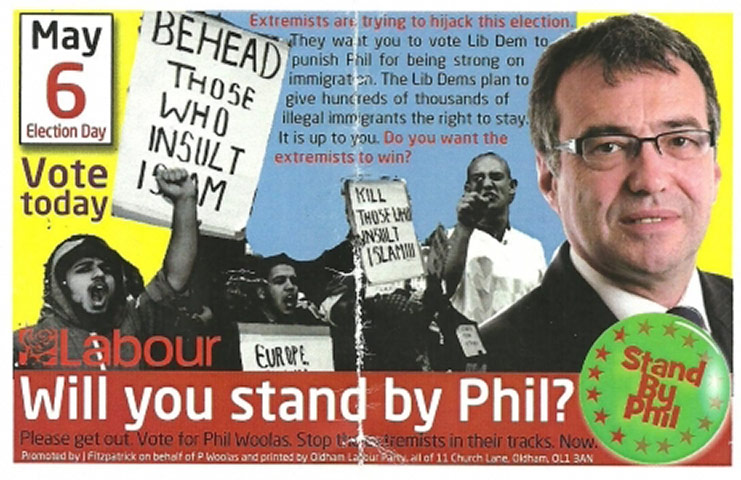
Phil Woolas' Hate Lit

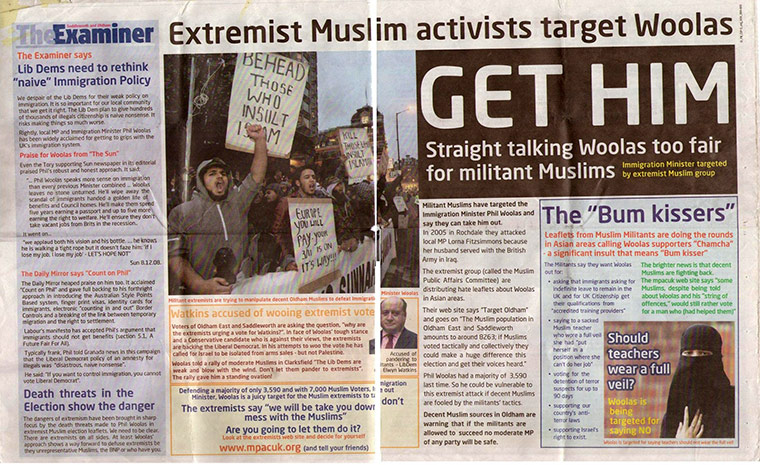
Former Labour immigration minister, Phil Woolas has been expelled from parliament, after a court ruled that he lied  about his Lib Dem election opponent having ties to Muslim extremists in his campaign hate literature show above in a deliberate attempt to the angry White vote. Woolas has also been banned from standing for public office for three years and it's expected that there will be a re-run for the Oldham East seat. That a politician has to resort to Islamophobic and xenophobic hype to get votes is bad enough, but for Labour MPs to vote him into Ed Miliband's shadow cabinet says a lot about the Labour party as a whole, considering Woolas has a track record of being anti-immigrants (remember the Gurkhas, the tier system for visas and foreign ID cards). Below is an extract from an on-point opinion piece by Dan Hodges from Labour Uncut on this issue: 

When Phil Woolas’ campaign took the decision to “get the white vote angry” it wasn’t an aberration. They were deploying a localised variation of a national strategy. When we, as a party, call for British jobs for British workers, or a ‘debate’ on immigration, we are speaking in code. And when the code is deciphered it says, “we think you’re racist, but we don’t care. We want you to vote for us anyway”.

When did Andy [Burnham], Ed [Miliband] and the other leadership contenders develop their keen interest in the socio-economic implications of mass migration? Where are Andy’s pamphlets? When were Ed’s adjournment debates? Their speeches, fringes, seminars? These are senior representatives of the mother of parliaments. If they really wanted a ‘debate’ they, more than anyone, have had ample opportunity to engage in one. We don’t want a debate. We want votes. And frankly, my dear, we don’t give a damn where they come from.

When the battle for the leadership reached its crescendo, who did David Miliband wheel out as one of his final endorsers? Mrs Duffy. “This new government is not on the side of people like Gillian Duffy”, he said, “I am determined the Labour party will be”. When his brother had finished his leadership speech, whose was one of the first adulatory hands he clasped? Gillian Duffy’s. Asked whether she thought he shared her views on immigration, she replied ”Most probably yes, it was very good”. Ed’s office said he was hoping to grab a cup of tea with her later.

Pandering to white working class prejudice isn’t the preserve of one junior immigration minister. It’s Labour’s official line to take. Every time the BNP makes a breakthrough, our response is the same; it’s a reaction, a cry for help. People are just protesting against the system. They’re not racist. 

The hell they’re not. At the last election the BNP secured 1.9% of the vote. Two percent of the country racist? We should be so lucky.

Wednesday, 3 November 2010

Diasporic Relations: Cleveland in Translation


by Mukoma wa Ngugi
Author of the novel Nairobi Heat (Penguin, SA 2009), an anthology of poetry titled Hurling Words at Consciousness (AWP, 2006) and is a political columnist for the BBC's Focus on Africa Magazine. He was short listed for the Caine Prize for African writing in 2009 and for the Penguin African Writing Prize in 2010.
I am sipping a cold Taj Mahal beer at Empress Taytu, the Ethiopian restaurant on Cleveland’s East Side. My wife, friends and I have just finished some doro wat stew and injera bread while our 10-day-old daughter, Nyambura, takes a nap.
I am a Kenyan claiming Ethiopian culture in order to feel at home. Perhaps years ago, it would have felt ironic, but not anymore.
I came to the United States in 1990 to attend college and reconnect with a father I hadn’t seen in eight years. A writer, he was living in political exile after using his pen against the dictatorship of Daniel Arap Moi. Leaving for a conference in London, he’d been told he’d receive a “red-carpet welcome” on his return — a euphemism for being jailed or killed.
I was able to leave Kenya only because I was born in Evanston, Ill. My parents had returned home shortly after my birth, so my first language is Gikuyu, and my English accent is unmistakably Kenyan. The dictatorship had denied my siblings passports — an attempt to punish my father — while I, armed with my birth certificate and Kenyan identification, was able to go to the American Embassy and get a U.S. passport.
So my return to the states was an escape. But because I had lived in Kenya all my life, it was not a return home; it was to begin the life of an immigrant in the country of my birth. To cope with my feelings of isolation in the racially polarized America of the 1990s — the time of the Rodney King beating, the Los Angeles riots and the O.J. Simpson trial — and the news from East Africa — the dictatorship intensifying in Kenya, the genocide unfolding in Rwanda — I sought the company and conversation of other Africans and African-Americans. I had to abandon a narrower Kenyan identity and embrace my Africanness and blackness.
Still, even today, I can get terribly homesick. But even though I left Kenya for very complex reasons, the cure is in finding small, mundane things that bring home back to me. Immigrants are forced out of their native lands by great upheavals: war, famine, oppression. But in our host countries, those larger issues become abstract. We miss small, practical things that function as metaphors for home. When we do find them, it is deeply satisfying. We feel like we have reconnected with our culture.
Finding such nuggets, though, is like translating between languages. I am constantly looking for the original or equivalent. At other times, I have to compensate and substitute. For example, I wanted to get married in a free-flowing African kitengeshirt, not straight-jacketed in a tuxedo. I couldn’t very well drive to Steelyard Commons for it. But at the Calabash African Market in Cleveland Heights, I found one with matching shorts.
Mostly, though, I am in search of food. If you love food as much as I do, food is culture. And for Kenyans, there is no substitute for goat meat. We eat roast goat at weddings and funerals, at birthday parties, in five- and one-star restaurants. There is an urban legend set in Cleveland of an elderly American couple who went out of town for a few days, leaving their pet goat under the care of a Kenyan student, who promptly threw a party. No need to spell out the fate of the goat, or the friendship.
So in 2007, when my wife and I moved to Cleveland from Wisconsin so that she could start medical school, I promptly found my way to the West Side Market. Although I cannot buy a whole goat there, a full leg for roasting gets the job done.
Sometimes, as a food lover and fumbling chef, I have to innovate. Indian naan flatbread replaces thicker Kenyan chapatis. And in order to make ugali, a hard cakelike dish made of maize, I must find the dry, white maize flour at a Hispanic or Asian grocer, since sweet, yellow American corn flour won’t do. Thus, I’ve also begun to experiment with foods from many different cultures — and now even make a mean pad thai.
Ultimately, some things do not translate. Last year, when I flew home and my brothers met me at the Nairobi airport, we immediately went out for goat and Tusker beer. In the restaurant, a lone musician was strumming his guitar, singing old favorites in Gikuyu. The audience did a Mugithi train dance, snaking and chugging around the dance floor. This is home at its essence — music, food, family and language.
But what Cleveland cannot give, it can compensate for in profound ways. My daughter was born here. Her roots, which I hope will span wider than mine or her mother’s, will always start here. We named her Nyambura, which translates into bringer of rain, after my late mother. Culturally speaking, my mother continues to live through her.
Translation means a word is reborn into a different language and culture. So isn’t my mother being reborn in Cleveland the ultimate act of translation?

*This essay first appeared in the October 2010 issue of Cleveland Magazine and re-produced @ www.africanwriting.com, now jacked by yours truly.