Showing posts with label Just for the Giggles. Show all posts

Wednesday, 9 February 2011

California on Egypt

While the Pew Research Centre has produced some very interesting research* to dispel the myth that Americans are not as ignorant as the rest of the world sometimes thinks they are,  some young people Cali are simply clueless. 
This is Kaseem G on the streets of Cali. 
#subscribetokaseemg!
* Pew Reasearch shows that +-32% of the public said that they kept up with news about the situation in Egypt and the Egyptian Revolution made up 56% of media coverage last week. This is said to be one of the 'highest levels of coverage for any story since PEJ started its weekly analysis four years ago -- and the highest for a foreign news story'. Kind of surprising given that America's fighting two wars and has military and humanitarian interests in so many countries around the world.


Friday, 21 January 2011

jacked from: http://xkcd.com/850/
'The world according to a group of Americans who turned out to be unexpectedly good at geography, derailing our attempt to illustrate their country’s attitude toward the rest of the world.'

Monday, 13 December 2010

The Foot-in-Mouth President & Cabinet


"I don't want one like this one. She may fail to pass through the
 door, breaking furniture with her heavy weight
 and even break the vehicle's shock absorbers." 


That's Ian Khama, President of Botswana, commenting on one of his cabinet ministers when describing the kind of wife he'd like.
And I thought Ian Khama was a bore, turns out he's got quite a sense of humour. The image of a woman so heavy she can break a car's shock absorbers had me in stitches for a minute, but what's even funnier is that it's said by an almost 60 year old man 'bout to tip into the grave in a minute. Good luck with waiting on that Beauty Queen to come around,
I hope she can tell a joke or two about you, Sir.


This selection of quotes from a story on All Africa published today includes some real gems from members of Khama's Cabinet:
Speaking at the country’s largest diamond mine, President Khama accused the Bushmen of living a ‘life of backwardness’ ‘a primitive life of deprivation co-existing alongside wild animals’, and ‘a primeval life of a bye [sic] gone era of hardship and indignity’....

...Last month, speaking to the BBC, Botswana’s minister of environment, wildlife and tourism said he didn’t believe ‘you would want to see your own kind living in the dark ages in the middle of nowhere as a choice, when you know that the world has moved forward and has become so technological’. The vice-president has also been quoted as questioning why the Bushmen must ‘continue to commune with the flora and fauna’ when they could ‘enjoy the better things in life, like driving Cadillacs’.
(source: All Africa)
Well that's the Khoi-San told inn'it? I mean, why live in the bush, for centuries relatively unpoisoned by the evils of modernity, when there are Cadillacs to be enjoyed and the better things in life to be attained, courtesy of Khama's government, of course? I'm sure the natural ecosystem would be happy to get on without the 'primitive' Bushmen who could do with a bit of civilizing, eh? 
And to the poor, urban-dwellers of Botswana, you have been cheated by 'life'. As you are 'modern people' there is no reason why you should not have the best of what life has to offer so I encourage you to go in your numbers, go and line up at the Minister of Environment's office and demand your Cadillacs because that's what 'life' has to offer. Never you mind that Botswana has as many Cadillacs as I can count on my hands and toes or that BMWs, Toyotas and Mercedes Benzs are what you'd most likely see being driven by those who enjoy the finer things in life, while you poor folk have to fight with the government to get basic unimportant stuff like electricity, health and affordable education. 
 It's not that this rather hip Minister has watched one too many Snoop and Fiddy videos or that he forgets what  his ministerial duties towards the environment actually entail, he's just telling it like it is, homies. So, good people of Botswana, go and demand your Cadillac. It is a modern citizen's birthright!
#getrichordietrying.

Wednesday, 8 December 2010

Zuma and the World Bank


S.A comedian Trevor Noah kills it! This was filmed earlier this year, but I only saw it few weeks ago so for those who haven't seen it, get your giggles on. 
For those who don't understand the Zulu/Ndebele:
at 1:19 did you give it to me in my hand?
at 1:27 you're crazy, I'll beat you up French! I'll beat you do you hear me?
at 1:37 hey Julius [Malema] bring my machine, bring it.


Monday, 6 December 2010

Copyright Ghensel, www.ghensel.preposterous.com

Saturday, 13 November 2010

Braap Braap, it's MacDaddy Museveni

In the busy life of a President, Prez Yoweri Museveni has found time to spit a few bars and make a rap video as part of his election campaign and to prove he's just as hip and up to date as young Ugandans. Yes, Sevo! I'm feeling both the original and the club mix, props to Fenon Records, however I'm not so keen on him having a fourth term in office, that's just my 2cents not being Ugandan and all.
Translation of nursery rhyme in Runyankore: 
He was given a knife, gave it to the people who harvested millet, gave the millet to the cattle keepers who in exchange gave him a cow which he took to the king and the king gave him a wife. The Wife gave birth to a son called Mugarura.    (fisttap politicalscrapbook)

Friday, 12 November 2010

Imitation is the Cutest Form of Flattery

Li'l Girl Dressed up as the fabulous Janelle Monae, all ready for Halloween.

I've no idea where the pic's from, found it on Threadbare via via via etc 
If you're reading this & it's yours, please can I have her, the kid I mean. : )

Friday, 22 October 2010


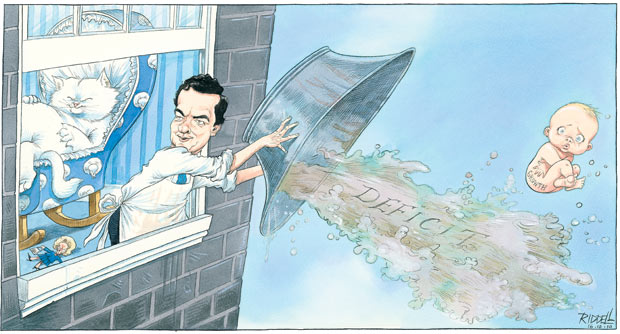
I warn you not to be ordinary. I warn you not to be young.
 I warn you not to fall ill. I warn you not to get old.
With Love, Gideon Osborne xxx
plagiarised from Neill Kinnock
pic by Chris Ridell (copyright) jacked from The Guardian

Friday, 27 August 2010

A Book Worth Burning

V.S Naipaul strikes again, this time in Africa. He recently returned from a six month trip to Uganda, Gabon, Nigeria, South Africa and Cote d'Ivoire and he's written a book about his travels. What he had to say reads like something out of an 18th century European explorer's narrative. Apart from helping to start a very big bonfire, the next best thing this book could be used for is script material for Uncle Ruckus in The Boondocks. This is an excerpt from the Evening Standard:

Essentially the book is Naipaul's idiosyncratic search for Africa's spiritual core. He collects experiences and stories of faith and belief on an odyssey across Uganda, Nigeria, Ivory Coast and Gabon — eventually travelling to South Africa, a country that he says he finds “mesmerising and profound”. But others he also found repellent, such as Ivory Coast: “I found out what was the best way of killing a cat or kitten. You put them in a sack of some sort and then you dropped the sack in a pot of boiling water. The thought of this everyday kitchen cruelty made everything else in Ivory Coast seem unimportant,” he writes.
The book is a dazzling spectacle of original travel reporting by the greatest living prose writer as he approaches 80, fearless in writing about what he sees and feels. In South Africa he notes human body parts made by witchdoctors into a mixture of so-called “battle medicine” for respectable middle-class Africans. Such images inevitably and understandably jar with those who want Africa to be progressive with economic hope for the 21st century. “I am nervous that people see the book as anti-Africa or use it to make some sort of political point,” Naipaul says. By choosing specifically not to dwell on the economics or the politics of Africa, he aimed to gauge what he perceived as the different inner nervous systems of Africa.

“Truth stares you in the face. You just pick it up and write it. It has not been my intention ever to create trouble, even from my very first book,” Naipaul says. He is more weary than wary of his armchair critics. “People who don't travel to look [for themselves] have their own precious principles, which … go beyond observation or truth and if you go against their principles with your observations, they do not like it. So that is the provocation.”

Naipaul is never deflected from what he perceives as harsh or unfashionable truths, however unpalatable. He has airily dismissed the Caribbean culture of the Seventies as “manufactured societies, labour camps”. Tony Blair was like a pirate who imposed on Britain a “plebian culture”. The fatwah by Ayatollah Khomeini on Salman Rushdie, he once joked, is an “extreme form of literary criticism”.
He is also used to the passage of time eventually making him seem more prophetic than provocative. When, 30 years ago, he wrote harshly about Islam as a potent global difficulty, he was castigated as a racial stirrer. Now his view is considered by many as mainstream. “What happens after a while is that what appears so bold, fire-burning and house-destroying eventually appears OK. I have gone out and done the work; that is my ticket really.”

His first visit to Africa was in the Sixties. This book was the result of his travels nearly 50 years on. “This time an unspoken aspect of my inquiry was the possibility of subversion of old Africa by the ways of the outside world. To witness the old world of magic was to be given some idea of its power and to be taken back to the beginning of things. To reach that beginning was the purpose of my book. To go in search of the beginning of things. It is very exciting, was at the time, to feel one is in touch with the beginnings of thought, the beginnings of metaphysical ideas. So that was what I meant by going back to the beginning — probably a romantic idea.”
The fact that there is no written culture in Africa, he says, was “a great drawback”, adding “I talked about this to people in Africa. They did not see it like that. They thought it just one of those little things that would be put right eventually. They did not see how fundamental it was not having a writing, a literature, a past you could turn to. I wondered why they could not do the writing.”
Not that he underestimates the power of “old Africa” but he sees it as limiting. “What they feel is very profound and it goes down to their very being. But they have no idea of history, though. No idea of a past. This is true of Africa generally. There is not a book in which you can see where you were 100 years ago and that for me is very disturbing.”

His soft hypnotic voice unleashes many stings in the tail. “I have been interested in earth religions that take you back to the remotest past of men.The simplicity took one's breath away. Yet profound belief comes from, as it were, very educated people, people with a gift of thought and everything else, and you can't say that about Africa, it is all emotion.”

For Naipaul, the country he found it hardest to get a handle on was South Africa. “I found it a very hard place to have a point of view, and that is half the battle. I became very frightened in a way that I was never frightened before. I felt stymied in South Africa and saw here race was everything; that race ran as deep as religion everywhere. I thought that I may not be able to do this book there. To be frightened was a new experience. I do not know whether it was age or what but it went away.”

Naipaul made his initial reputation in fiction with A House for Mr Biswas but his Noble Prize for Literature was as much for his travel writing as his novels. “There are few rules for travel, for instance, not too much about oneself — you have to be a seeing eye or a feeling mind.” He was intensely curious about the behaviour of the people, and the stories he encountered, and was at times shocked. “The unhappiness that people get caught up in, the women who try to kill their children — all of that was new to me.”
He was very moved by the sight of the vast forests in Gabon but he also saw and heard things there that chilled him to the bone. “There is a bad side, certainly in Gabon, they kill and the kinds of people they like to kill are children — it has to be a child or an older person, children because they are nearer to the beginning, an old person because they are near the end of life. All very sinister,” he says.
Naipaul may have gone in search of faith in Africa but he has none himself. “I believe in the endless processing of experience. My philosophical attitude does away with the need for faith. I also have no fear of death. None at all,” he says.

His mind is still razor sharp — this new book means a world tour — and his career has ben bolstered by having recently hired Andrew “The Jackal” Wylie as his new literary agent. Naipaul says he would like to please him by writing a novel next. But he simply does not know if he has it in him. He has been reading a book about how Oscar Wilde no longer wanted to write after he came out of jail. “His editor pressing him to write was asking him to become unhappy. Wilde wanted to be happy at that stage after coming out of jail. So I am just wondering if for a man of nearly 80 writing another book is inviting a kind of unhappiness on himself?”


Monday, 23 August 2010

Monday Giggles Brought to You by News of The World

This past weekend saw the return of yet another series of the UK's biggest singing competition, the X Factor. Among the hopefuls was Gamuchirai Nhengu from Zimbabwe, currently living in Scotland. She has a beautiful voice and did her mom proud on stage, I hope she goes very far in the contest... However, the tabloid press just couldn't resist hyping it up. The News of the World takes the cup for the most idiotic headline and gutter press journalism par excellence! 


Peep this: 

'THE Scots girl who wowed millions on last night's X Factor is a survivor of evil dictator Robert Mugabe's brutal regime in Zimbabwe.
Gamu Nhengu, 18, escaped the horror which left tens of thousands dead - either murdered, starved or killed by disease. 


Her mum Nokutula, 38, fled in 2005 and found refuge in Tillicoultry, Clacks, with Gamu and sons Milton, 11, and Marty, ten.
A family friend said last night: "It's unimaginable what they must have been through.  "There's a melancholy about her that tugs at your heart strings. She must miss her home." Gamu's unique rendition of Katrina and the Waves' 1983 hit Walking on Sunshine had the audience on their feet screaming. And the charismatic student's stage confidence dissolved when she tearfully told judges: "This means everything.
"I want to give something back to my mum, she has worked so hard."
All four gave Gamu a a yes, and she's tipped as a front runner. '

...Needless to say this is absolute rubbish, but it makes for  good Monday laugh. It has all the right 'Africa's the Heart of Darkness' buzzwords and is filled with just the right dose of Mugabe is Hitler rhetoric, plus two absurdities thrown into the mix for 1xtra comedy: i. she 'beat' Mugabe (errr how exactly? Is he secretly on X Factor or is she secretly the new Prez'nit of Zimbabwe?) ii. she is a 'Scots girl' but she is a Zimbabwean - I distinctly remember her stating that she is a Zimbabwean who moved to Scotland and Scottish citizenship does not yet exist (although it is a national and ethnic identity), so she is either a Zimbabwean national living in Scotland or a British citizen orginally from Zimbabwe.


Anyway here's Gamu's performance, she reminded me of Fantasia Burinno when she was on American Idol, they kinda look alike. The meedja really need to leave her alone to do her thing on the show, this overhyping of her talent by any means necessary is dangerous, irresponsible reporting and also very untruthful. This isn't about Mugabe - iBetchu her mother has no political affiliations whatsoever and like many Zimbabweans is an economic migrant forced to leave because of the economy. And yea sure she can sing, but let her prove her worth on stage, rather than the press manipulating viewer's opinions with so much coverage - unsurprisingly the usual suspects, The Sun, the Daily Mail have been at it, but none quite like News of the World...


Shame abt XFactor using autochoon on some contestants, it was uneccessary, because this girl can SANG! Best of luck to Gamu!

Wednesday, 11 August 2010

Who Killed Captain Alex?


Produced by Ramon Film Productions in Kampala and described as Uganda's first and greatest action movie, this flick prolly beats any wild action flick coming out of Nollywood and even Hollywood gotsta bow down to this! Who Killed Captain Alex? is set in Kampala shorty after a police raid in which Captain Alex and  drug dealer's brother are murdered and both the gangsters and police seek to avenge the deaths. According to the Ugandan Newspaper, The Observer, the film cost 8 million shillings (US $3500) and the police refused to provide the filmmakers with any support apart from uniforms - on their request list were guns, tankers and helicopters. (lol!)

From The Observer: It is a well scripted movie, but the visuals are too graphic. Nabwama says, he just wanted to produce an action movie, acted, produced and directed by Ugandans. But he can’t be forgiven for using toy guns and pistols in the production.
“When we approached CPS about the project, we were told that we [film industry] are not yet at that level. They could only provide us with police uniforms,” he says. “But we had asked them to provide us with helicopters, guns, tankers and access to army barracks. So we had to settle for the computer.”

...Apparently there's a sequel on the way.
fisttap PetinaGappah & GeekSystem

Monday, 28 June 2010

THREE LIONS MAULLLLLED!!!


pics by Tom Jenkins, jacked from The Guardian

I just gotta gloat and rub it in for all my friends who support England:
 The Three Lions got mauled, I told you so!
The Ref should've allowed Lampard's goal and made it 2-2 then the score may have been 6-2.
 SCHweeeet!!!

Friday, 25 June 2010

Pink Moët: The Preferred Drink of 'Heroes' of the Struggle Everywhere

Brother Cde Julius Malema (aka Bra Julius or Juju), leader of the ANC Youth League
sippin' on some champipple to quench his throat after belting out 'Kill the Boer' ooops, I mean 'Kiss The Boer'. It's a hard knock life.

jacked from thirdworldgoesforth, pic Daily Maverick

FYI: I actually agree with some of what Bra Julius says about the song, Kill the Boer in the video, but when Bra Julius does Julius Malema Zim war-vet style, then we have a huge problem, I mean h.u.g.e.

Thursday, 17 June 2010

Maradona and his vuvuzela...shwoooof!
fisttap mahala.co.za

Sunday, 13 June 2010

Saturday, 3 April 2010

How Not to Write About Africa


Written by the brilliant, Binyavanga Wainaina

Just for the Giggles: When Miranda met Caliban


Meet Meitkini a 23 year old Masai Warrior and Colette a 24 year old English girl who decided to drop out of the Sorbonne in Paris to go 'find herself'...in Africa. In the process of 'finding herself', she fell in love with Meitkini. The story is ridiculous enough as it is, but the Daily Mail just takes it to another level. (oupa an'a leeevel - as my man Jus' wld say in slang Afrikaans) It reads like a modern day Heart of Darkness (Joseph Conrad) meets The Tempest (William Shakespeare), only this time there's no Prospero to prevent Miranda from falling in love with Caliban in the 'Heart of Darkness'. i'Ve bolded, supersized, italicised n reddened my fav bits, like a school teacher so you won't have to strain too hard to see what iSee...Happy reads.

The DM UK reads...Like many young women in love, Colette Armand believes she was hit by a coup de foudre when she first saw her future husband. 'The attraction was instant,' she says. 'We had an immediate connection.' Photographs testify to the strength of their bond, showing a beaming young couple clearly delighted by each other's company.
That, however, is where the conventional nature of their romance ends. For Colette's intended is a Masai warrior whose home is a mud hut on the vast African plains. Meitkini's tribe have no possessions and no running water, and their food is either plucked from the ground or killed with a spear... Nonetheless, after a courtship of three years, Colette, 24, is preparing to abandon all the comforts of her western lifestyle to join her life permanently with his - even though, to date, she hasn't shared so much as a kiss with her 23-year-old fiance, as Masai rules forbid physical contact between men and women who aren't married. What's more, she has to accept that, in the future, she may have to share her husband with other women, as Masai tradition permits any number of wives. 'In time I may have to accept that he will marry again,' she says. 'I hope he chooses not to take another wife, but if not then I will compromise.'


Colette admits that she never expected her life to end up on such an unusual path. The daughter of a nurse and a businessman, her father's job, as director of a large mining company, took the family all over the world. Academically gifted, at 17 she was studying literature at the Sorbonne in Paris. At 21, disillusioned with her studies and with a failed romance behind her, she decided to take a gap year - 'I realised I needed to have an adventure and try and find myself. 'In the space of a week I quit my studies, withdrew all my savings and got on a flight to Nairobi. I didn't tell anyone what I was doing, except my mum, who was hysterical. She thought I was throwing away all my hard work. But I'd made up my mind.'


So, within 24 hours, Colette had swapped the comfort of her apartment for a rug on the floor of the orphanage, which had no electricity nor running water. Among them was Mumbe, a nine-year-old boy who, prior to Colette's arrival, had never spoken a word. 'One day, he turned to me and said "mummy",' she recalls. 'It was a huge shock, and everyone at the orphanage thought I had magical healing properties.'

So much so that word spread, and a few days later, one of Colette's supervisors told her that the head of a local Masai tribe wanted to meet her. The tribe lived several hours drive away over dusty, uneven terrain.
'When I got there I was taken to meet the chief, Kehmini, who was incredibly welcoming. I was lucky that the tribe spoke quite good English, so I could communicate well. Kehmini then invited me to stay, and showed me to a hut that would be my home while I was there,' she recalls.

Even after the privations of the orphanage, her first night was spent in insomniac discomfort. 'There are no doors on the hut, so I was terrified a snake would slither in,' she recalls. 'I lay there listening to every movement.' The next morning she was further shocked by the harsh realities of life in the Masai. 'The only water came from a small muddy tributary that's home to snakes and crocodiles,' says Colette. 'I was too scared to bathe, so I had to resort to having a makeshift wash in water boiled on the fire - which is what I ended up doing for months to come.'

Nonetheless, she quickly grew to love the simple rhythm of life with the tribe. 'A typical day starts at 4am and ends at 6pm, when everyone sits around the campfire, and cooks and talks. You go to sleep at seven. In the morning, the men go out hunting and the women look after the children and work in the fields. The beauty of sitting under a vast African moon by the campfire, or watching the sun rise over the plain, is hard to describe.'

The tribe quickly took her to their heart, and after two weeks Colette was told the community had decided to sacrifice a goat as a welcoming gift - a huge honour. 'They slaughtered it in front of me, which was horrible, then put its warm blood in a cup for me to drink. It tasted disgusting, but I had to do it as I would have hugely offended them otherwise. I just closed my eyes and tried not to be sick.'

But for all these privations, Colette soon realised she had no desire to leave - a feeling enhanced when, a few days later, she first saw her future husband while she was picking coffee beans in the fields. 'Meitkini was the chief's brother, but I hadn't seen him before as he'd been away hunting for several weeks. When I first saw him he was striding towards me carrying a lion he had helped kill, and he looked like this incredibly masculine force. I was smitten.

Later, when I was introduced to him by the chief and we started talking, it was like speaking to my double. He was clever and articulate, and there was an immediate connection. From then on I was in love.' Meitkini, she says, felt the same way, but Masai relationships do not adhere to the same conventions as they do in the West. 'The Masai don't marry for love but for power and social position, so it is a slightly alien concept. It was a long time before we were able to acknowledge our feelings for each other, and we couldn't express them physically, as Masai rules forbid physical contact between unmarried men and women. It was frustrating, but I had to respect their culture. I was a visitor and it would have been a gross insult to behave any other way.'

Instead, Colette waited, hoping the tribe would grow to trust her. 'Five months later, Kehmini told me the community had accepted me and would be happy for me to live there permanently. It was a huge honour.' Yet there was one final hurdle to overcome - Colette felt an overwhelming urge to finish her studies back home before she could commit to her new life in Kenya. 'It was tough because I loved him, but the intellectual side of me wanted fulfilment too.' Colette recalls.

'I talked to Meitkini about it and he told me he would wait for me.' Matters came to a head when, in October 2008, with civil unrest sweeping the country, a passing UNESCO charity worker told her that, as a white woman, she was in huge danger and urged her to leave Kenya for a while. 'I was scared but also upset - I didn't want to leave Meitkini, but he said I should take the chance to return to England and study for a while. There were a lot of tears.' But there were happier tidings too: before she left, the tribe's chief gave Colette and Meitkini his blessing to marry. 'He said the whole tribe felt something special had happened between us and that we were destined to be together.'

Colette returned to England, moving in with friends into a small flat in south-east London, and quickly being accepted onto her PhD course. But life in the West no longer felt familiar. 'For three weeks, I barely left my room. I felt like a stranger in my own culture - the sheer noise of city life gave me a splitting headache. I realised I now thought of Africa as my home, and I was determined to go back.'

Unsurprisingly, her conviction has proved incomprehensible to many of her friends, who cannot grasp why Colette wants to turn her back on the luxuries of western life. 'Obviously, some of them have found it hard to understand - they just cannot conceive of what my life is like there. At the same time they can clearly see how happy I am, and none of them have tried to talk me out of it,' she says.

Sadly, the same cannot be said of her mother, who is still unable to accept Colette's decision and remains estranged from her daughter. (Her father's opinion isn't known, as he walked out on her mother when Colette was 12, and hasn't seen his daughter since.) 'The fact that I'm going to marry a Masai is a scandal in the family and, as a result, she and I don't speak. It's sad, but we're very different people,' she says. And so Colette is making the final plans for her wedding. It will be a two-day affair, with Masai travelling from miles around to celebrate their union, and an ox slaughtered in honour of the happy couple. That, however, is where the festivities will end, and afterwards Colette will be back in the fields at dawn, planting grain or harvesting coffee beans.

'It's a simple life, and one that would be anathema to most people in the West, but it makes me happy,' she says. 'I have no problem with giving up my western ways. When I'm there I feel so alive and free. Living with the tribe has taught me to live in the present. It taught me what matters.'

Thursday, 18 March 2010

Playing the Race Card...

A handy li'l card made for South African politicians (one Julius Malema in particular), but this nifty li'l thing has universal application, it saves any 'race victims'  the trouble of having to explain why they 'deserve' 'victim' status and yelling 'racist!' when something, anything and even nothing goes wrong! Get yours at www.theracecard.co.za 
iCould think of a few peoples who'd need these, esp the Honorary Whites Card.